
"What is delightful is that chess pieces can be appreciated not only as musical instruments, but also as works of art."
 "What is delightful is that chess pieces can be appreciated not only as musical instruments, but also as works of art."
After spending so much of your life around chessboards, what is it like to see chess pieces that are more than game objects—actual works of art?
 illustration
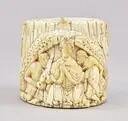
This cylindrical chess piece depicts a king seated in a robe and cloak. Two servants stand beside him: one offers a sword, while the other carries a shield. On the opposite side, five figures are carved beneath archways. They are the king’s advisers, and one of them holds a falcon. Unlike the geometric chess pieces that first arrived from the East, those produced later in the West grew more figurative, representing kings, queens, assorted figures, and animals. Their intricate designs made the pieces decorative objects as well, reflecting social status and a measure of power in 12th-century society.
The King and His Advisers shows people preparing for battle. Do you have any particular rituals that help you get ready for an important match?I try not to attach too much importance to rituals. What makes being a grandmaster distinctive is the constant travel—from one country to another, taking part in different tournaments and seeing new places. I enjoy it: I get to explore many countries, meet all kinds of people, and experience different cultures. It is deeply rewarding. Still, this way of life can make discipline difficult and a regular routine hard to maintain.I keep working toward a few specific goals: getting enough rest, preparing thoroughly, and arriving without unnecessary stress. That means sticking to a healthy sleep routine, avoiding heavy meals before a match, and exercising regularly. A chess match can last up to six hours, so being in excellent physical condition helps me maintain concentration for the entire duration.
Who has been the most influential adviser in your professional life? Was it a coach, a family member, a friend—or perhaps even an opponent?All of them, really. My first mentor was my mother, who shaped my education from the very beginning. She introduced me to chess when I was three years old. A chess coach in Russia, she still teaches children every day. From her, I inherited both my love of the game and my strong work ethic.
 illustration
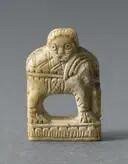
This ivory carving depicts an elephant. Subtle grooves across its back suggest tack, while the head of a man rises above it—the mahout who guides and cares for the animal. The chess piece is an early form of the modern bishop. In another chess tradition that developed from India and Persia, the comparable piece was called the alfil, an Old Persian word meaning “elephant,” and took the form of a tower that moved diagonally. Only in the 13th century did it become the piece we know today as the bishop.
The piece called the Elephant and Mahout corresponds to the bishop. Is an elephant really the right symbol for the bishop, or would another animal represent it better? I think the comparison works very well. The bishop has strength, but also a certain subtlety. It is considered a minor piece, like the knight, rather than a major piece such as the queen or rook. Even so, it can be remarkably powerful and may sometimes outperform the knight because it can move across great distances.Traditionally, the bishop has been linked to elephants. Chess originated in India, where elephants were used in military operations, and that connection survives in the names given to the piece in some languages. In Russian, for example, it is called “slon,” meaning “elephant.” Yet when chess first reached Europe, elephants probably meant little to local players, who began developing alternative representations more suited to their own surroundings.
 illustration
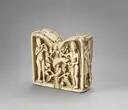
This elaborately carved chess piece dates from the 12th century. On one of its two principal faces, two knights confront each other with lances. The other shows Adam and Eve committing the original sin beneath the Tree of Life, while the serpent that tempted them winds around the trunk. Along the narrower edges, the couple work after their transgression: Adam tills the earth in a short tunic, and Eve spins with a distaff. Near the top, two four-legged animals—perhaps dogs, wolves, or stylized bears—appear in finely carved low relief. Often called a tower or castle, the piece is the predecessor of the rook. The word traces back to the Persian rukh, meaning “chariot,” and later became rocca—the Italian word for “fortress”—as it passed through Italy. The rook’s tower-like shape became prominent in the 16th century.Here, Adam and Eve stand for original sin and, with it, the idea of temptation. A chess game can be lost in much the same way: by giving in to the appeal of a dazzling move, an easy choice, a sacrifice, or a risk that was never justified.
Extravagant gestures and noble sacrifices are easy to find tempting. They may look beautiful, but that does not make them the right decision.Sometimes a combination seems worth trying even when it probably will not work. Its beauty can be hard to resist, though, and emotional involvement may cloud your judgment. The mistake can cost you the game.The world’s best players stand out for their discipline. It shows in the work they do away from tournaments and in the way they analyze decisions during matches. Seen through the lens of temptation, that analysis makes the dangers within a chess match especially clear.
 illustration
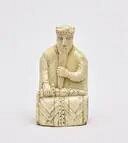
Seated on his throne and looking straight ahead, the crowned sovereign holds his sword’s hilt in one hand and grips his beard with the other, a gesture that represents authority and growth in Scandinavian tradition. The sword lies across his lap, while his pose recalls several kings from the Lewis chess pieces, now housed at the British Museum in London. This piece is distinctive: it is the only known representation of a king holding his beard. Inlay appears to have decorated the crown, the orphreys of his clothing, and the sword’s cross-guard, marking the object as a valuable artifact and a sign of wealth.
When does the king stop being the wise old figure stroking his beard and start taking an active part in the game? Often, the shift happens far sooner than expected.Typically, the king stays out of the action until the endgame, when it moves toward the center of the board. What makes this piece remarkable, though, is that once the threats on the chessboard have diminished significantly, it can become a formidable weapon.Once most of the pieces are off the board, the king can become much more active. In certain queen endgames, moving it toward the center may even be part of the plan. Strong players know exactly when to make that move.
Of these four artworks, Adam and Eve is the one that resonates with me most. It centers on temptation, and that connects closely with a basic part of chess: staying focused, disciplined, and clear-minded. A move may look appealing or dramatic, or seem effective because I want it to be. Still, I have to resist the impulse to play it for those reasons alone.This principle reaches beyond chess and applies to life as well. A useful question to ask is whether the idea actually holds up or whether I am clinging to it because I want to believe it. We often gravitate toward conclusions that serve our interests, which makes it necessary to question our own thinking.
In an official tournament, would pieces like these change the way you play? I don’t think so—or only minimally. Once a chess player enters tournament mode, the pieces are no longer seen simply as physical objects. They become abstract representations, and their significance is understood without having to view them as tangible figures.Players usually prefer classic pieces because they are less distracting. Once positions enter the picture, though, thinking about the game starts to resemble mathematics. A dot, an arrow, or a figure makes no difference; in the mind, each represents the same idea.
People often say that a chess match is a work of art. Do you think chess should be considered an art form?Yes—without question. Chess has the qualities of art, even though it is also classified as a sport, a game, and a science.Chess becomes an art form through exquisite combinations and the solving of studies—constructed positions in which one must find a single, often highly creative solution. I also experience that artistry when I devise a beautiful strategy or an engaging idea to carry out on the board, especially when I sacrifice a piece and the remaining elements begin to work together in harmony.However, when the aim is victory or some particular result, chess becomes a sport. Studied systematically, it takes on the character of a science. Yet in front of an audience—or quietly in Paris’s Luxembourg Garden—it is still a game.
Issu d’un échange avec Noham Selcer.