
Spanish Painting at the Louvre
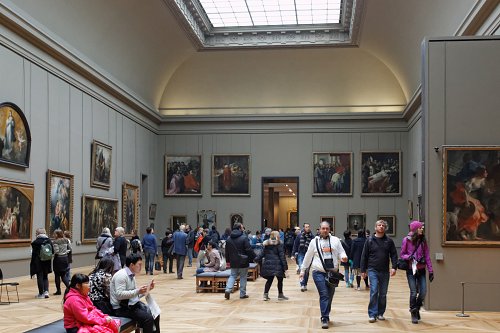 Spanish Painting (Denon wing, level 1)
Smaller than you'd expect
The Louvre's Spanish painting collection fits into a few rooms on the first floor of the Denon Wing. It's not large compared to the Prado, but it punches above its weight. The paintings here tend to be the ones that left Spain early, through war, diplomacy, or the art market, and several are among the best-known works by their respective artists.
Spain's golden age of painting ran roughly from the late 1500s to the late 1600s, and the Louvre covers it with enough depth to make the visit worthwhile. The collection grew through two main channels: acquisitions during and after the Napoleonic Wars, and purchases from Louis-Philippe's Galerie Espagnole, which opened in 1838 and was dispersed after the 1848 revolution.
El Greco and the mystics
El Greco's Christ on the Cross Adored by Two Donors shows the elongated figures and cold, unearthly palette that made him impossible to categorize in his own time. Born in Crete, trained in Venice, working in Toledo, El Greco painted like nobody else. The Louvre also holds his Christ on the Cross, a starker composition against a dark sky.
Francisco de Zurbarán painted monks, saints, and still lifes with a directness that borders on blunt. His Saint Bonaventure on His Bier shows the dead Franciscan lying in state, and the painting's restraint is what gives it power. No theatrics, no drama. Just the body, the robes, and the light.
Ribera and Murillo
Jusepe de Ribera spent most of his career in Naples but remained Spanish in his sensibility. His The Club-Footed Boy, painted in 1642, shows a young beggar grinning at the viewer while holding up a note requesting alms. The painting is hard to read. It could be sympathetic, it could be unsentimental. Ribera doesn't tell you how to feel about it.
Bartolomé Esteban Murillo painted in a softer register. His The Young Beggar shows a boy sitting in shadow, delousing himself. Unlike Ribera's beggar, Murillo's is absorbed in his own world, unaware of being watched. The two paintings, hung in the same wing, make an interesting pair.
Goya
Francisco de Goya closes the chronological sequence. The Louvre holds several portraits, including the Marquesa de la Solana and a self-portrait. Goya's later work grows darker and stranger, but the pieces here are from his years as a court painter, when he was still producing elegant likenesses for the Spanish aristocracy. Even so, there's an edge to these portraits that distinguishes them from their French equivalents. Goya looked at his sitters with a clarity that not everyone appreciated.
How the collection was built
Napoleon's armies seized paintings from Spanish churches and collections during the Peninsular War. Some were returned after 1815, but not all. Louis-Philippe assembled a Spanish gallery at the Louvre in 1838, drawing on purchases and loans. When he was overthrown in 1848, the gallery was closed and the collection scattered at auction. The Louvre managed to retain or later reacquire several key works. Later purchases and donations filled gaps, but the collection's shape was largely set by these 19th-century events.