
Guided tours of the Louvre Museum
Guided tours of the Louvre Museum
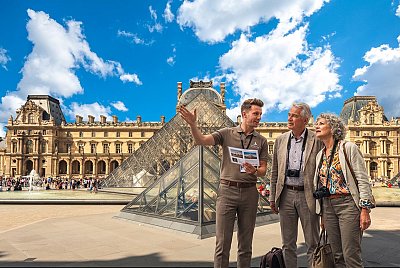
Why bother with a guide?
The Louvre holds around 35,000 works spread across 73,000 square metres in three wings. Without a plan, most people spend their first 30 minutes figuring out how to get from the Pyramid to the Mona Lisa, and the next two hours wandering through rooms they did not mean to enter. A guided tour fixes that problem. Someone who knows the building walks you through a curated route, keeps you on schedule, and tells you things about the art that you would never pick up from a wall label.
That last part matters more than you might think. The Louvre's information panels are short by design — a title, a date, maybe a sentence. A guide fills in the gaps: why Delacroix painted Liberty leading a charge in contemporary clothes, what the missing arms of the Venus de Milo might have been doing, why Napoleon III's apartments look the way they do. Context turns a room full of old objects into something that actually sticks with you.
Highlights tours
The most popular format, and for good reason. A highlights tour typically runs two to three hours and covers the works most visitors want to see: the Mona Lisa, the Winged Victory of Samothrace, the Venus de Milo, Vermeer's Lacemaker, the French Crown Jewels, and a handful of others depending on the guide and the route. These tours usually include skip-the-line access, which during peak months (April through August) can save you an hour or more of queuing at the Pyramid.
If this is your first visit and you have limited time, a highlights tour is the most efficient way to see the greatest hits without spending half the morning lost in the Egyptian antiquities wing. Not that the Egyptian wing is bad — it is excellent — but it is easy to lose track of time there when you meant to be looking at Italian Renaissance paintings.
Thematic and in-depth tours
For repeat visitors or anyone with specific interests, thematic tours go deeper into a single collection or period. You might spend two hours on Italian Renaissance masters, or trace the history of French painting from Poussin to David. Some tours focus on the building itself — the Louvre was a royal palace for centuries before it became a museum, and the architecture tells its own story, from the medieval fortress foundations in the basement to the gilded apartments upstairs.
Others zero in on mythology in art, the ancient civilisations of Mesopotamia and Egypt, or the decorative arts collection, which tends to get overlooked despite having rooms that rival Versailles for sheer opulence. These tours suit people who already saw the Mona Lisa last time and want something different.
Evening and small-group tours
On Wednesday and Friday evenings, the Louvre stays open until 9 p.m. Evening tours take advantage of the thinner crowds. Seeing the Grande Galerie with half the usual foot traffic changes the experience considerably — you can actually stand in front of a painting without someone's phone blocking your view. Small-group tours, typically capped at six to eight people, offer a similar benefit. The guide can adjust the pace, answer questions without shouting, and take detours if the group is curious about something off the standard route.
Family tours
The Louvre with children requires a different approach. Kids do not care about brushwork techniques or provenance, but they do care about stories — battles, monsters, shipwrecks, crowns. Family-oriented tours lean into that. The guides pick works that lend themselves to storytelling and keep the pace short enough that nobody melts down from museum fatigue. Most family tours run 90 minutes to two hours, which is about the right window for children under 12.
Picking the right tour
It depends on what you want out of the visit. First-timers with a few hours should start with a highlights tour. Anyone who has been before and wants depth should look at thematic options. Families with young children need a tour designed for them — a standard adult tour at full pace will not work. And if crowds bother you, an evening or small-group tour is worth the premium.
Scroll through the guided tour options below to compare what each one covers, how long it lasts, and what is included in the price.