
Greek Pottery in the Galerie Campana
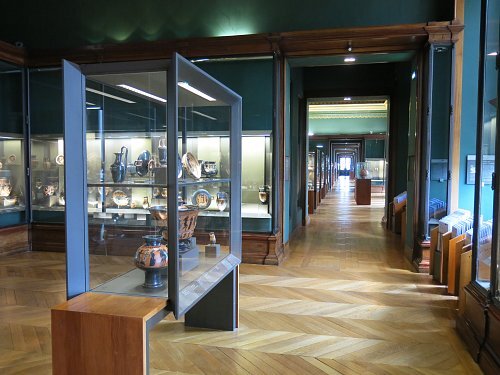 The Galerie Campana gathers the rooms 651 to 659 of the greek antiquities
A bankrupt marquis and eleven thousand objects
Giampietro Campana was the director general of the Monte di Pietà, a papal charitable trust that functioned as a pawnbroker in Rome. He used the position's access to funds to build one of the largest private art collections in 19th-century Europe. When the Vatican caught him embezzling in 1857, the collection was confiscated and put up for sale. Napoleon III bought the bulk of it in March 1861: 11,835 objects for 4,800,000 francs, paid from his personal funds.
Among the haul was the largest collection of Greek vases anyone had assembled to that point. The Louvre inaugurated a dedicated gallery for them in 1863, with Napoleon III in attendance. The gallery has carried Campana's name ever since, which is an odd kind of immortality for a man who died in disgrace.
Nine rooms, a thousand years of pottery
The Galerie Campana runs through nine rooms on the first floor of the Sully Wing, rooms 651 through 659. The walls are painted an empire green that dates back to the original installation, and the ceilings carry historical scenes painted under the Restoration and the July Monarchy in the 1820s and 1830s, before the vases arrived.
Room 659 works as an introduction. It presents Greek pottery through three lenses: the shapes potters used, the techniques they developed, and the mythological scenes they painted. From there, room 658 packs in a denser display organized by type and date. Rooms 655 through 651 follow a chronological path from the 9th century BC to the 1st, sorted by era and production center. You watch the decoration evolve from abstract geometric patterns to animal friezes, then to human figures, and finally to the complex narrative scenes of the red-figure technique.
Black-figure, red-figure, and what they mean
The two dominant techniques on display are black-figure and red-figure painting. Black-figure came first, around the 7th century BC: the potter painted figures in black slip on the natural red clay and then scratched in the details with a sharp tool. Red-figure, invented in Athens around 530 BC, reversed the process. Figures were left in the natural clay color while the background was painted black. It allowed finer detail, subtler expressions, more complex compositions. The Louvre's collection covers both techniques thoroughly, with enough examples to see the transition happen piece by piece.
Greek potters figured out how to achieve an intense black sheen through a three-stage firing process that controlled oxygen flow in the kiln. The technique was lost after antiquity and only understood by modern archaeologists in the 20th century.
Pieces that stop you
The Eurytios Krater, a Corinthian black-figure column krater from about 600 BC, shows Heracles feasting with Eurytios and his daughter Iole. It was found at Cerveteri and is one of the most important pieces of Corinthian vase painting to survive. On the other side, Ajax fights and dies. The whole surface is covered with figures, animals, riders.
A red-figure bell-krater by the Berlin Painter depicts Ganymede, the young Trojan prince abducted by Zeus. The Berlin Painter is one of those anonymous figures known only by the style of a single vase that happened to end up in Berlin, and his work here is precise, almost architectural in its use of space.
The Eumenides Krater, an Apulian red-figure piece, shows a scene from Aeschylus's Oresteia. And there's a red-figure bell-krater featuring Europa riding Zeus in bull form that has an afterlife of its own: the image was adapted as the watermark used on euro banknotes.
What happened to the gallery
The collection has been displayed in roughly the same configuration since the 1860s, which is itself unusual for the Louvre. The green walls, the vases in their cases, the painted ceilings overhead. Campana wanted a comprehensive survey of Greek pottery and that's more or less what you still get.
In November 2025, the Louvre closed the Galerie Campana after a technical report flagged the fragility of certain beams in the Sully quadrangle. It was a precautionary measure, not a collapse, but the gallery has remained shut since. Whether the closure leads to a renovation or a longer-term rethinking of the display remains to be seen. For now, the eleven thousand objects sit behind closed doors.