
Islamic Art at the Louvre
 Islamic Art (Denon wing, levels -2 and -1)
Under a golden veil
The Louvre's Islamic art galleries sit beneath the Cour Visconti, one of the museum's internal courtyards. In 2012, architects Mario Bellini and Rudy Ricciotti installed a roof made of tessellated glass triangles sandwiched between two layers of anodized aluminium mesh. From outside, it catches light like a gold mesh fabric draped across the courtyard. From below, it filters daylight into something softer. People call it a flying carpet, a Bedouin tent, a dragonfly wing. The architects probably intended all three.
Two of the gallery's three floors are underground. The upper level, at courtyard grade, covers the 7th through 10th centuries. The lower level handles the 11th through 19th. Over 3,000 objects in total, pulled from a geographic range that runs from Spain to India and from the earliest caliphates through the Ottoman Empire.
How the department came to be
The Louvre first showed Islamic objects in 1893, but they sat inside other departments for over a century. The Islamic Art department became its own entity by executive order in 2003, making it the museum's eighth curatorial department and the newest. The Al Waleed bin Talal Foundation helped fund the new galleries, and the €100 million project took nearly a decade to complete.
The collection had been stored in the Richelieu Wing's basement before the move. Giving it a dedicated space in the Cour Visconti was a statement about how seriously the Louvre intended to treat the material. The opening in September 2012 was one of the bigger events in the museum's recent history.
The Baptistère de Saint-Louis
The single most famous object in the collection is a brass basin inlaid with silver and gold, known as the Baptistère de Saint-Louis. The name is misleading. It was made in Syria or Egypt around 1320-1340, roughly fifty years after King Louis IX died. The connection to Saint Louis is a later invention. What's documented is that it was used as a baptismal font for the future Louis XIII, and later for Napoleon III's son. The metalwork is intricate enough that it rewards close looking: riders, huntsmen, fish, and courtly scenes cover every surface.
Other objects worth finding
The Pyxis of al-Mughira is a carved ivory box from 10th-century Córdoba, made for the son of the Umayyad caliph. The carving is dense with figures, animals, and vegetal patterns. It's one of the finest surviving examples of Umayyad ivory work.
The carpet collection on the lower level is large and hard to rush through. Persian, Ottoman, Mughal, and Mamluk examples fill long display cases. A 16th-century Safavid carpet, still vivid in its reds and blues, is one of those objects that makes you reconsider what's possible with wool and dye.
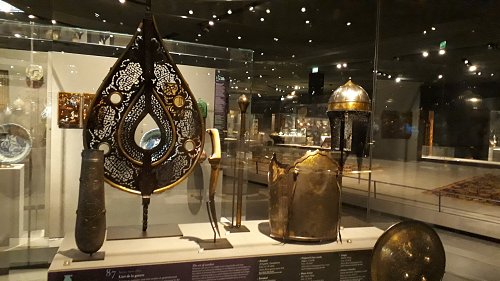
Ceramics are everywhere. Iznik tiles from Ottoman Turkey, lustreware from Iran, pieces from Samarkand. A blue-and-white dish from 14th-century Syria sits near Chinese-influenced wares that show how far trade routes carried aesthetic ideas. Metalwork, too: ewers, incense burners, astrolabes, candlesticks. Each object represents a specific place and period, but together they trace how ideas about decoration, geometry, and calligraphy moved across an enormous territory over twelve centuries.
The space itself
The galleries are quieter than most parts of the Louvre. Partly because of the underground location, partly because the collection is less famous than the paintings upstairs. The lighting is kept low to protect textiles and works on paper, and the Bellini-Ricciotti canopy overhead produces a quality of light that changes through the day. On a sunny afternoon the mesh throws faint golden patterns across the floor. It's one of the few places in the museum where the architecture competes with the objects, and the objects hold their own.