
Roman Antiquities
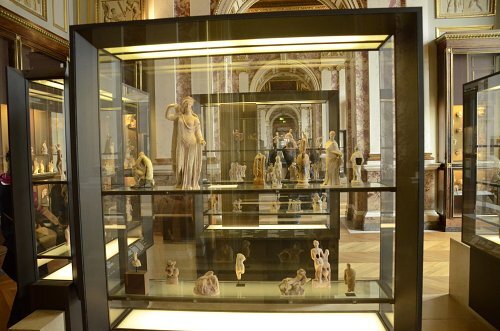 Roman Antiquities (Denon wing, level 0)
Napoleon's shopping trip
A large part of the Louvre's Roman collection arrived in 1807, when Napoleon pressured his brother-in-law Camillo Borghese into selling roughly 700 pieces from the Borghese family's holdings in Rome. It was technically a purchase, but Camillo didn't have much say in the matter. The price was 13 million francs, paid partly in cash and partly in Italian property. The deal gave the Louvre some of the most important Roman sculptures outside Italy, and it gave Camillo a difficult family dinner.
The galleries sit on the ground floor of the Denon Wing. You reach them after passing through the Greek rooms, which sets up a natural transition from Hellenistic work to Roman copies and Roman originals.
The Borghese Gladiator
The Borghese Gladiator is the collection's best-known piece, though the name is wrong twice over. It's not a gladiator and it wasn't made in Rome. The marble sculpture was carved by Agasias of Ephesus around 100 BC and shows a warrior lunging forward, probably fighting a mounted opponent. It was found before 1611 at Anzio, among the ruins of one of Nero's seaside palaces.
For two centuries after its discovery, the Borghese Gladiator was one of the most studied and copied sculptures in Europe. Artists used it as a reference for anatomy and movement. Wrongly restored with a sword and shield at various points, it was misidentified as a gladiator early on and the name stuck. It came to Paris with the rest of the Borghese purchase and has been in the Louvre since.
Portraits and propaganda
The Roman portrait collection runs from the late Republic through the imperial period. A marble head of Julius Caesar, several Augustus portraits, and a colossal bust of Hadrian give you a cross-section of how Roman leaders wanted to be seen. The republican portraits are blunt and unflattering in the Roman veristic tradition, all wrinkles and jowls. The imperial ones smooth out and idealize, following Greek models. You can watch the shift happen within a few rooms.
There's a group of imperial-era sarcophagi carved with mythological and battle scenes. The relief work on some of them is dense enough to occupy you for a while. A sarcophagus showing Dionysiac scenes, with satyrs and maenads winding through a vine-covered landscape, is one of the finer examples.
Mosaics and daily life
Floor mosaics from Roman villas in North Africa and the eastern Mediterranean are mounted on the walls. A large mosaic depicting the Seasons from a villa in Antioch shows the Roman taste for decorating floors with images that guests would walk over at dinner parties. The tesserae are small enough that from a few steps back, the images resolve into something close to painting.
Bronzes, glass, and small objects round out the collection. Oil lamps, surgical instruments, coins, jewelry. A bronze statuette of a dancing lar, the kind of household spirit that Romans kept by their front doors, is one of those small objects that tells you more about how people lived than any marble emperor can.
Between Greece and Rome
One of the complications with Roman sculpture is that much of it is copies of Greek originals. The Romans admired Greek art and had workshops mass-produce marble versions of famous bronzes that have since been lost. In some cases, the Louvre's Roman copy is the only surviving record of a Greek original. The galleries handle this honestly, noting what's a copy and what's not, but the line between Roman collecting and Roman creating is never entirely clean.