
The Galerie d'Apollon
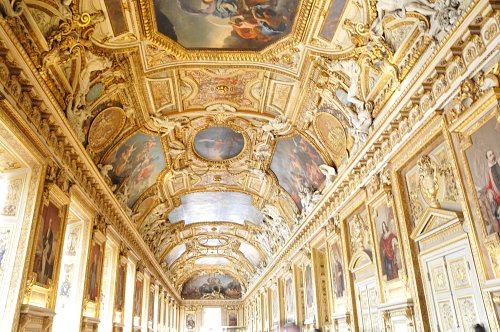 The Galerie d'Apollon
A gallery that took two centuries to finish
On February 6, 1661, a fire gutted the upper floor of the Petite Galerie at the Louvre. Louis XIV was twenty-two. Rather than simply repair the damage, he ordered architect Louis Le Vau to rebuild the space entirely, and brought in Charles Le Brun to paint it. The theme Le Brun chose was Apollo, the sun god, and the choice was not subtle. Louis wanted a room that said something about himself.
Le Brun designed the ceiling program, François Girardon handled the stucco work, and a team of gilders and painters filled the vault with allegories of the sun's movement through time and the seasons. The gallery was meant to be the first great statement of Louis XIV's reign. In a way it was, though not as planned: the king lost interest in the Louvre, moved to Versailles, and Le Brun took his skills to the Hall of Mirrors instead. The Galerie d'Apollon was left unfinished.
It stayed that way for nearly two hundred years. Architect Félix Duban finally took on the completion in the mid-1800s, and he made one decision that proved more lasting than anything else about the project: he gave the central ceiling panel to Eugène Delacroix.
Delacroix's ceiling
Apollo Slays the Python, finished in 1851, is the painting that ties the room together. Delacroix worked on it for about two years. The composition shows Apollo in his chariot firing arrows at the serpent Python, and the color and movement are recognizably Delacroix even from sixty feet below. It's a Romantic painting installed in a Baroque room, and the contrast works better than it should. President Louis-Napoléon Bonaparte inaugurated the completed gallery on June 5, 1851.
The rest of the ceiling is Le Brun's original 1660s work, or close to it, with later contributions from Joseph Guichard and Charles Louis Müller filling in panels that Le Brun never got around to. Thomas Regnaudin and the Marsy brothers did stucco figures along the vault. When you look up, you're seeing the work of at least half a dozen artists spread across two centuries, and somehow it holds together.
The Crown Jewels
The gallery also houses what remains of the French Crown Jewels. François I started the collection in 1532. It grew with every subsequent king, peaked under Louis XV, and then the Third Republic sold most of it off in 1887 to prevent any future monarch from claiming it. They kept 23 pieces of particular historical value and put them in the Galerie d'Apollon, where they've been since.
The Regent Diamond is the centerpiece. Found in India in 1698, cut in London using the then-new brilliant cut technique, it weighs 140 carats and is considered one of the purest large diamonds ever found. Philippe II, Duke of Orléans, bought it in 1717 while serving as regent for the young Louis XV. It sat in Louis XV's coronation crown, then Louis XVI's hat, and eventually Napoleon had it set into the hilt of his ceremonial sword, which tells you something about how Napoleon thought about jewelry.
The Hortensia Diamond sits nearby, a 20-carat orange-pink stone that Louis XIV purchased. The Sancy, pale yellow and 55 carats, has a longer paper trail than most European monarchs: it passed through the hands of multiple royal families before landing here. Crowns commissioned for Louis XV and Napoleon are also on display, though behind glass that was redesigned in 2020 by Juan Felipe Alarcon.
What it feels like to walk in
Henry James visited at thirteen, in 1856, and later wrote about experiencing "a general sense of glory" that mixed beauty, art, fame, and power into something he couldn't quite separate. That's about right. The room is 60 meters of gilt, painted ceilings, and stucco figures, and even on a crowded Tuesday it manages to feel excessive in a way that the rest of the Louvre does not.
A renovation between 2001 and 2004 cleaned up the gilt and paint. Further work in 2019 addressed accumulated grime. The wrought iron gate at the entrance dates to 1819, when architect Pierre Fontaine installed it. He hadn't commissioned it. He seized it from the Château de Maisons in 1797, which is a very French revolutionary thing to do with a gate.
In October 2025, thieves disguised as construction workers broke through a second-floor window and stole eight pieces from the Crown Jewels collection, valued at roughly 88 million euros. They were in and out in under eight minutes. Several pieces have since been recovered, but the incident prompted a complete rethink of the gallery's security systems.