
The palace: rooms, galleries, and architecture of the Louvre
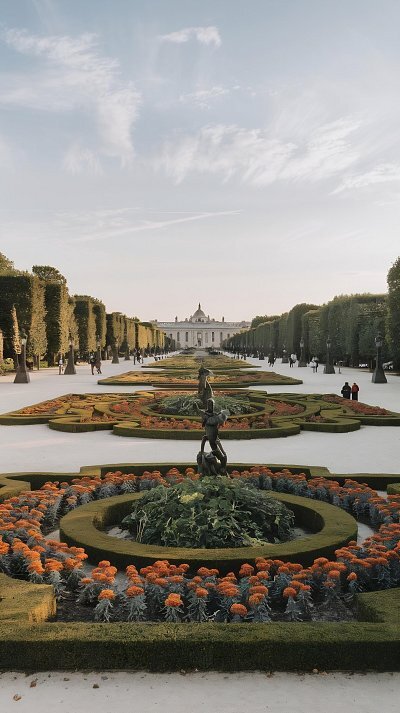
The Carrousel Garden: an open-air sculpture museum
Between the glass Pyramid and the Tuileries, the Carrousel Garden covers 6.2 hectares of manicured yew hedges, gravel paths, and bronze sculptures. The site gets its name from an extravagant equestrian festival held in June 1662, when Louis XIV gathered roughly 1,300 riders and up to 15,000 spectators to celebrate the birth of his son. For centuries after, the area served as the main courtyard of the Tuileries Palace. When the Communards burned the palace in 1871, the ruins stood for another twelve years before they were finally demolished, leaving the space open.
From flowerbeds to Maillol bronzes
The garden changed shape several times. Architect Edmond Guillaume redesigned it in 1889 for the World's Fair, filling it with academic statuary and French-style flowerbeds. In 1964, Culture Minister André Malraux and collector Dina Vierny replaced most of that statuary with twenty bronze works by Aristide Maillol — pieces like La Méditerranée, La Nuit, and La Rivière — turning the garden into a permanent outdoor gallery. The current layout dates from the 1990s Grand Louvre project, when Belgian landscape architects Jacques and Peter Wirtz redesigned the space with radiating hedge rows centred on the Arc du Carrousel.
The Arc du Carrousel
Built between 1806 and 1808 under Napoleon, the arch draws on Rome's Arch of Septimius Severus. Three openings sit between columns of red marble, with bas-reliefs depicting battles and statues of soldiers from the Grande Armée. On top, gilded figures of Victory and Peace drive a four-horse chariot — a replacement by sculptor François-Joseph Bosio after the original went back to Venice in 1815. The monument had major conservation work between 2022 and 2024. Beneath the garden itself sits a concrete slab covering a shopping centre, car parks, and equipment rooms — none of which you would guess from the surface.
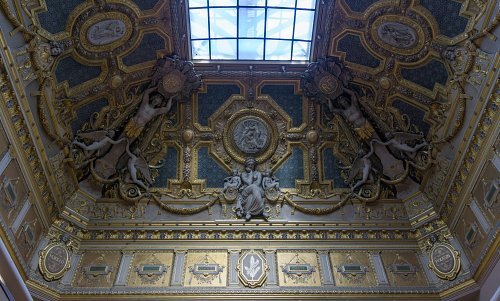
The Salon Carré: where art criticism was born
Despite its name meaning "square room," the Salon Carré is rectangular. The confusion comes from the French use of carré to describe a room with right angles, not equal sides. Architect Louis Le Vau designed the space after a fire in 1661, placing it as a connector between the Galerie d'Apollon and the Grande Galerie. When Louis XIV moved the court to Versailles in 1682, the Royal Academy of Painting and Sculpture took over the room in 1692, and it became the site of annual exhibitions from 1737 onward.
The birth of the Salon
Those exhibitions — held yearly, then twice a year from 1747 — became major events in Parisian life. Critics like Denis Diderot attended them, wrote reviews, and could make or break an artist's reputation in a single paragraph. This was, for all practical purposes, the beginning of art criticism as a public practice. In 1789, the room gained a glass roof that flooded it with natural overhead light, making it one of the first purpose-lit exhibition spaces anywhere. After the Revolution opened the Salon to artists outside the Academy, the shows eventually outgrew the space and moved in 1848. Architect Félix Duban then transformed the room into a museum gallery with an elaborate ceiling of blue, gold, and stucco by sculptor Pierre Charles Simart.
What you see today
Since 1971, the Salon Carré has held Italian Primitives from the 14th and 15th centuries: works by Cimabue, Giotto, Fra Angelico, and Uccello's Battle of San Romano among them. It is also the room where Napoleon married Marie Louise of Austria on April 2, 1810 — the paintings were taken down for the ceremony and put back afterward. If you walk through today, the overhead light still works the way it did in 1789, casting an even glow across some of the oldest panel paintings in the collection.
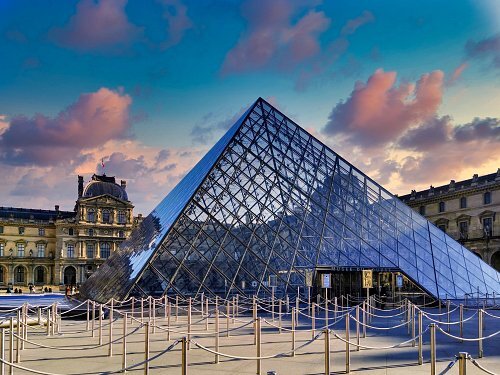
The Pyramid: I.M. Pei's glass entrance
The glass Pyramid in the Cour Napoléon is the most recognisable piece of architecture at the Louvre, and it almost did not happen. When President François Mitterrand appointed Chinese-American architect Ieoh Ming Pei in July 1983, the public reaction was harsh. Critics attacked the design as an insult to the historic palace. Pei held his ground, arguing that the geometry of squares and triangles was itself French in origin, inspired by André Le Nôtre's garden layouts. Construction took four years and required ship-rigging companies to assemble the metal framework. The Pyramid was inaugurated on March 29, 1989.
Numbers worth knowing
The structure stands 21 metres tall on a 35-metre base, covering 1,000 square metres. Its surface is made of 675 diamond-shaped glass panes and 118 triangular ones, held together by 6,000 steel bars and girders meeting at 2,150 nodes. The steel frame weighs 95 tonnes; the glazed aluminium frame adds another 105. The glass itself was a technical challenge — Pei wanted perfectly clear panels so the palace facades would remain visible from inside. Saint-Gobain spent two years developing extra-clear glass, producing 2,000 square metres of custom 21-millimetre glazing that had not existed before.
Five pyramids, not one
Most visitors only notice the main Pyramid, but the Louvre actually has five. Two smaller ones in the Cour Napoléon bring natural light down to the wing entrances below ground. A fifth — the Pyramide Inversée — hangs upside down at the entrance to the underground Carrousel shopping area, made of 84 diamond-shaped and 28 triangular panes. Pei also solved a tricky alignment problem: because the Seine bends between the Louvre and the Tuileries, the palace and the garden are not on the same axis. He placed a statue of Louis XIV in front of the Pyramid to create a visual line running through the Tuileries, the Place de la Concorde, and the Champs-Élysées all the way to the Grande Arche de la Défense.
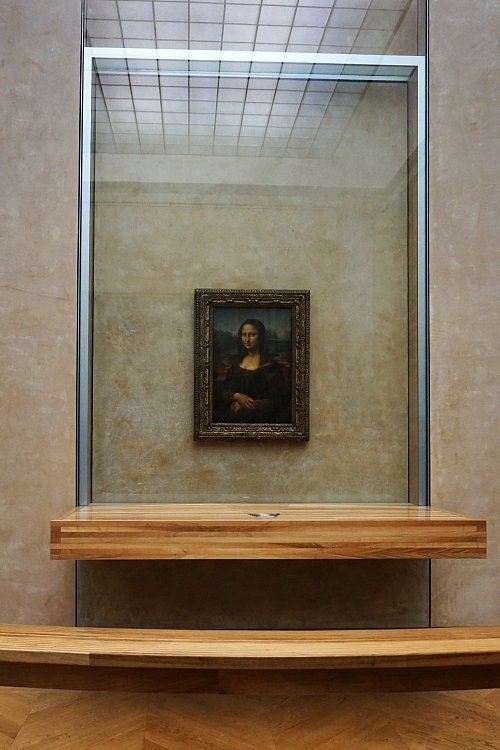
The Salle des États: the Mona Lisa and the Wedding Feast at Cana
Room 711 in the Denon wing is the largest room in the palace, and it contains the two works that generate the most foot traffic in the entire museum. On one wall, behind temperature-controlled glass since 2005, hangs Leonardo da Vinci's Mona Lisa — a portrait of Lisa Gherardini, wife of Florentine silk merchant Francesco del Giocondo, painted on a poplar wood panel that has warped and cracked over five centuries. King François I acquired the painting directly from Leonardo in 1518. On the opposite wall, Veronese's Wedding Feast at Cana takes up an area of over six metres high and nearly ten metres wide, depicting around 130 figures at a banquet. Veronese originally painted it for a monastery refectory on Venice's San Giorgio Maggiore island. Napoleon's forces confiscated it in 1798, and France kept it in 1815 because officials argued the canvas was too fragile to transport back.
A room with several past lives
Architect Hector Lefuel built the Salle des États between 1855 and 1857. Under Napoleon III, the room hosted legislative sessions. After 1870 it displayed 19th-century French paintings. It only became a home for Venetian art after the Second World War. In 2019, the walls were repainted a deep midnight blue to set off the rich colour palette of works by Titian, Tintoretto, and Veronese — including Titian's Man with a Glove, Tintoretto's Coronation of the Virgin, and Veronese's Supper at Emmaus.
The 1911 theft
On August 21, 1911, Vincenzo Peruggia — a glazier who had done work inside the museum — walked out with the Mona Lisa hidden under his coat. The painting stayed missing for over two years before Peruggia tried to sell it to an Italian art dealer and was caught. The theft, oddly enough, did more for the painting's fame than anything Leonardo himself could have predicted.
The Venus de Milo and the Galerie des Antiques
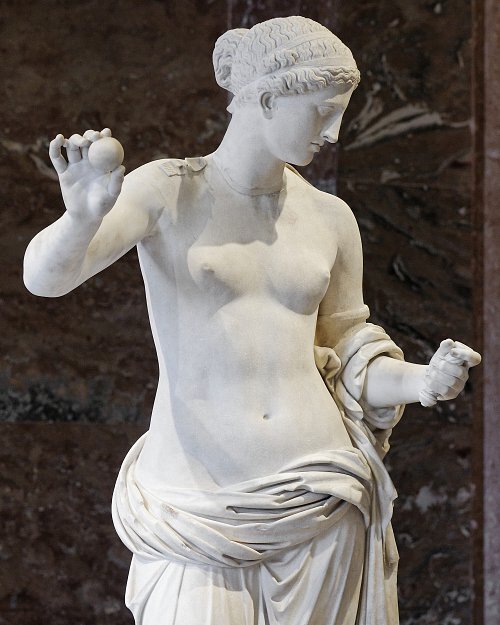
The Venus de Milo was pulled from the earth on the Greek island of Melos in 1820, in pieces. The French ambassador to Greece, Marquis de Rivière, acquired the fragments and presented them to King Louis XVIII, who donated the reassembled statue to the Louvre in March 1821. It now stands alone in Room 345 of the Sully wing, displayed in relative solitude so visitors can walk around it. The figure is carved from Parian marble in several separate blocks: the torso and legs join at the hips, and the arms were attached separately. A mounting hole at the left shoulder confirms this, though the arms themselves have never been found.
Aphrodite or someone else?
The missing arms are the reason art historians have spent two centuries debating who the statue actually represents. The leading theory is Aphrodite, the goddess of love — supported by the half-nude form, traces of former jewellery, and a separately carved hand holding an apple (Aphrodite's attribute) found nearby during the excavation. Others have argued for Amphitrite, a sea goddess associated with the island. The ambiguity has not hurt the statue's appeal. If anything, the mystery of the missing arms is half the reason people queue to see it.
The galleries around her
The rooms surrounding the Venus trace the history of Greek sculpture through originals and Roman copies: the Venus of Arles, the Ares Borghèse, and a series of Aphrodite types in different poses and periods. The gallery itself dates to 1811, when architects Percier and Fontaine completed an expansion decorated in red and grey marble to house antiquities from Napoleon's Italian campaigns and the Borghèse collection, purchased in 1807.
The Daru staircase and the Winged Victory of Samothrace
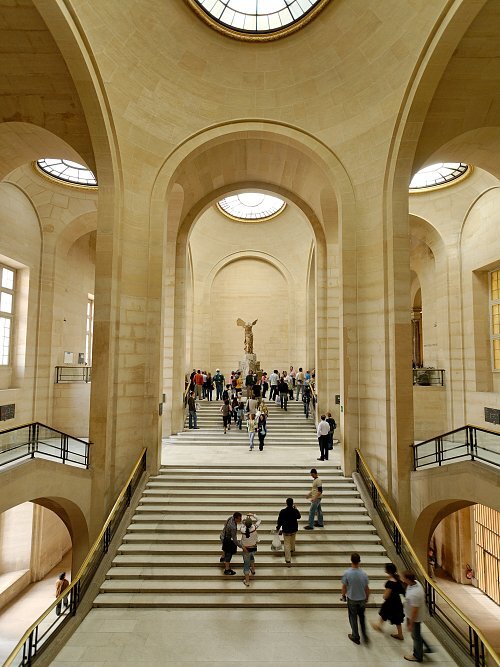
You hear the Winged Victory before you see it properly. The Daru staircase in the Denon wing funnels visitors upward toward the landing where the statue stands, and the crowd noise builds with every step. The sculpture represents Nike, the goddess of Victory, about to land on the prow of a warship whose sailors have just won a battle at sea. It was carved from Parian marble around 190 BC, likely commissioned by the inhabitants of Rhodes as an offering to the gods of Samothrace. Archaeologist Charles Champoiseau dug it up in 1863 in roughly 110 fragments. A second expedition in 1879 recovered the ship's prow and base. The head and arms have never been found. Only the right hand turned up — unearthed by Austrian archaeologists in 1875, completed as a plaster reconstruction in 1950. It measures 27 centimetres.
The staircase itself
Architect Hector Lefuel designed the Daru staircase during the 1850s and 1860s as part of Napoleon III's expansion of the Louvre. It is one of six grand staircases built during the Second Empire, spanning three levels with four directional paths to connect the expanded galleries. The Victory was placed at the top landing in 1883. The original décor around the statue featured heavily gilded mosaics that drew criticism for competing with the sculpture. In 1934, those mosaics were replaced with simpler surfaces that let the marble do the talking.
A deliberate stage
The placement is no accident. The staircase rises toward the statue from below, which means you first see the Victory from an angle that emphasises the forward thrust of the body, the spread of the wings, and the wind pressing the drapery against the figure's torso. It is one of the most carefully staged encounters in any museum in the world, and it has worked on visitors for over 140 years.
The Crypt of the Sphinx and the Egyptian galleries
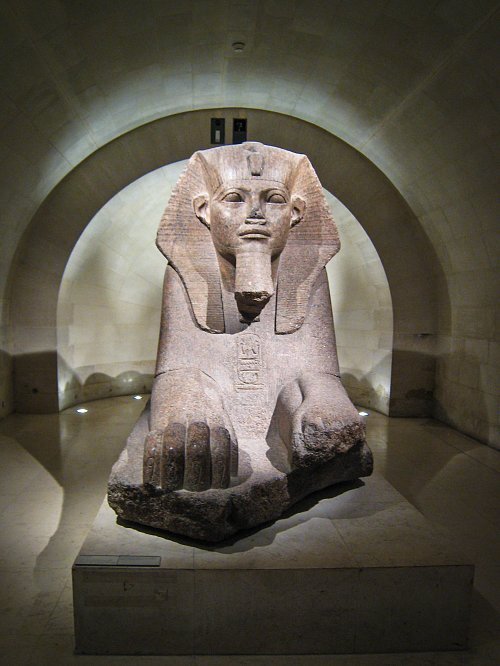
The Great Sphinx of Tanis greets visitors at the entrance to the Egyptian antiquities department, in Room 338 on the lower level of the Sully wing. The sphinx is half-lion, half-human — a creature with the body of an animal and the face of a king — and it has been guarding these galleries since Jean-François Champollion opened the Louvre's first Egyptian museum in 1827 with just four rooms. Champollion had deciphered hieroglyphs five years earlier, at the age of 32, and convinced King Charles X to purchase a collection for Paris. Today the department holds over 6,000 works covering nearly 5,000 years of Egyptian history across two floors.
What the two levels cover
The lower level is organised by theme. You walk through rooms on the Nile and its flooding cycles, daily life, tomb construction, hieroglyphic writing, and funerary rites. The reconstructed Mastaba of Akhethotep — an Old Kingdom tomb chapel purchased from the Egyptian government in 1903 and reassembled stone by stone — fills an entire room with painted low-relief carvings of agriculture, animals, and daily routines from around 2400 BC. The Crypt of Osiris holds sarcophagi, coffins, and mummy wrappings. The upper level, on the first floor of the Sully wing, follows a chronological thread from prehistory through the Ptolemaic Period, with royal statues of Sesostris III, Hatshepsut, Amenhotep III, Akhenaten, and Ramesses II.
The Seated Scribe
Of all the objects in the department, the Seated Scribe gets the most attention. The figure sits cross-legged with a papyrus roll across his knees, and his eyes — inlaid with rock crystal — seem to follow you around the room. It is a trick of the material and the craftsmanship, but it works every time. The statue represents a high-ranking official from the Old Kingdom, and despite being over 4,000 years old, the expression on his face feels startlingly present.
The Musée Charles X: a royal setting for Egyptian antiquities
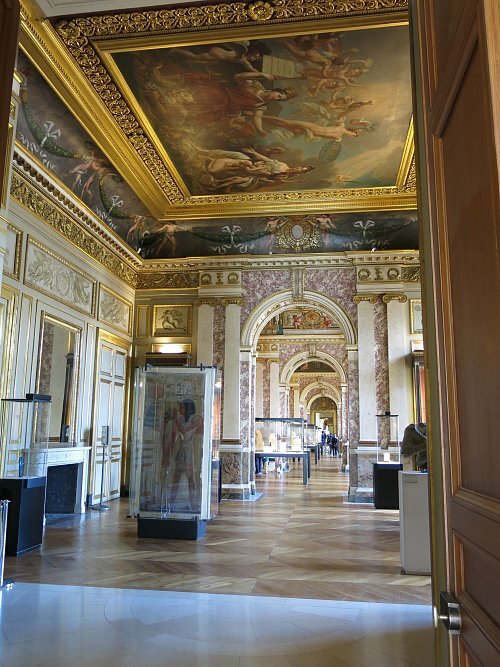
On December 15, 1827, King Charles X attended the inauguration of the Louvre's first Egyptian museum — nine rooms on the first floor of the Sully wing, in what had been the queen's apartments. Champollion, fresh from deciphering hieroglyphs and setting up an Egyptian museum in Turin, directed the installation. Architects Charles Percier and Pierre Fontaine connected the rooms with high openings that echo triumphal arches, framed in stucco imitating pink and white marble, with gilding picking out the architectural details. The ceilings were painted by some of the most prominent artists of the period: Antoine-Jean Gros, Horace Vernet, and Jean-Auguste-Dominique Ingres, whose Apotheosis of Homer remains one of the standout works overhead.
What the rooms hold
The original Musée Charles X rooms now display a chronological presentation running from the New Kingdom through the Ptolemaic Period. Among the key pieces: colossal statues of Ramesses II, the bronze statue of Karomama (a divine adoratrice of Amun, covered in gold and silver inlay), the Bowl of General Djehuty, a relief carving from Sethos I's tomb, and a pendant bearing the name of King Osorkon II. The rooms also contain stelae, ostraca, and smaller objects that fill out the everyday texture of ancient Egyptian civilisation.
The setting as part of the experience
What makes these galleries unusual is the collision between the objects and the architecture. You are looking at 3,000-year-old Egyptian artefacts inside rooms decorated in early 19th-century French neoclassical style, under ceilings painted by Ingres. The contrast is deliberate — Champollion and the architects wanted the surroundings to dignify the collection. Whether it works or feels slightly surreal depends on your tolerance for gilded stucco, but either way it is unlike any other Egyptian gallery in the world.
The Grande Galerie: Italian painting in perspective
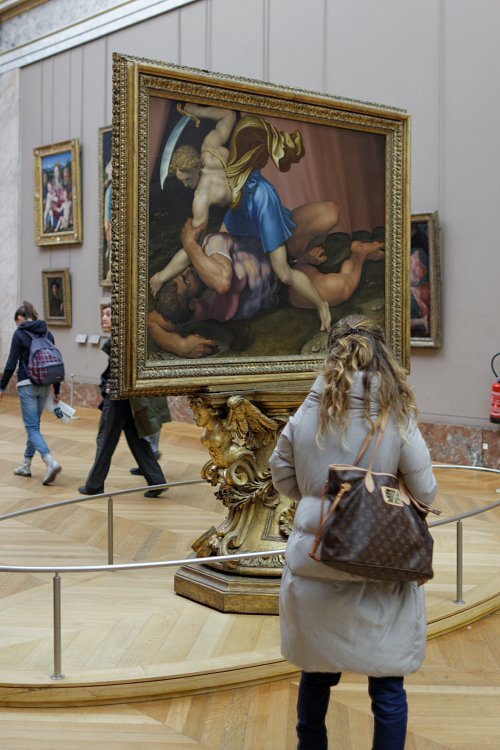
The Grande Galerie, Room 710 in the Denon wing, runs 460 metres along the Seine and was the longest gallery corridor in Europe when Henri IV commissioned it in 1595. Architects Louis Métezeau and Jacques Androuet du Cerceau built it to connect the Louvre with the Tuileries Palace. Louis XIII used it as a playground. Under Louis XIV, the first floor displayed works by Royal Academy members while the ground floor housed artist studios and living quarters. After the Revolution, the space opened to the public on August 10, 1793, as the Muséum central des arts — the moment the Louvre officially became a museum.
The collection on the walls
Today the Grande Galerie holds the world's largest collection of paintings by Leonardo da Vinci: The Virgin and Child with Saint Anne, Saint John the Baptist, La Belle Ferronnière, and The Virgin of the Rocks. King François I had invited Leonardo to the French court, and the paintings entered the royal collection directly. Beyond Leonardo, the gallery walls carry works by Raphael (La Belle Jardinière, the portrait of Balthazar Castiglione), Caravaggio (The Death of the Virgin), Mantegna (Saint Sebastian), Arcimboldo (Winter, Spring), and Ghirlandaio's unforgettable Portrait of an Old Man and a Boy.
Light from above
Under Napoleon, architects Percier and Fontaine broke the corridor into nine bays separated by columns and arches. Later, Hector Lefuel added skylights during the Second Empire, flooding the gallery with natural light that falls evenly across the paintings without glare. On April 2, 1810, Napoleon and Marie-Louise of Austria walked the full length of this gallery on their way to their wedding ceremony in the Salon Carré. It is still one of the longest straight walks you can take inside any building in Paris.
The Galerie d'Apollon: sun, gold, and the Crown Jewels
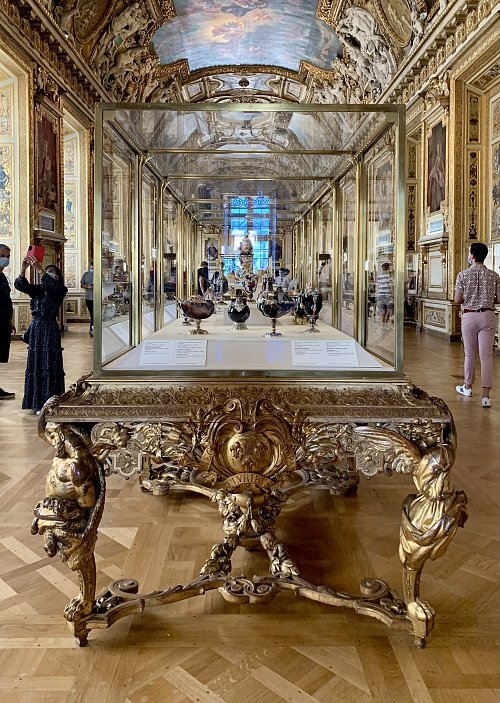
A fire destroyed the Petite Galerie in 1661, and Louis XIV — twenty-three years old and already committed to his sun-king image — ordered a replacement themed around Apollo. Charles Le Brun, First Painter to the king, directed the decoration: a vaulted ceiling showing Apollo's chariot crossing the sky from dawn to night, surrounded by zodiac signs, seasons, continents, and hours. The gallery became the blueprint for the Hall of Mirrors at Versailles, which Le Brun and his team built two decades later using the same visual language on a larger scale.
Delacroix finishes the ceiling
Le Brun never completed the central panel. It stayed empty for nearly two centuries until Eugène Delacroix painted Apollo Slaying the Serpent Python in 1850, a twelve-metre canvas that injected Romantic colour and energy into a Baroque room. Félix Duban oversaw the final restoration and completion of the gallery's decorative programme around the same time. The walls carry 28 portrait tapestries of French monarchs and artists, and the display cases below hold Louis XIV's collection of roughly 800 hardstone vessels — bowls and cups carved from agate, amethyst, lapis lazuli, jade, and rock crystal, mounted in precious metals.
The diamonds
The Galerie d'Apollon also houses the French Crown Jewels. The Regent diamond, 140 carats, purchased in 1717 by Philippe d'Orléans. The Sancy and the Hortensia. The Côte de Bretagne spinel, which once belonged to Anne de Bretagne. Jewellery sets of Empress Marie Louise. And a lapis lazuli ship-shaped table ornament representing Neptune. The room is currently closed for restoration, but when it reopens, the combination of Le Brun's ceiling, Delacroix's canvas, the hardstone collection, and the diamonds makes it one of the most concentrated displays of French royal opulence in existence.
The Red Rooms: monumental French painting
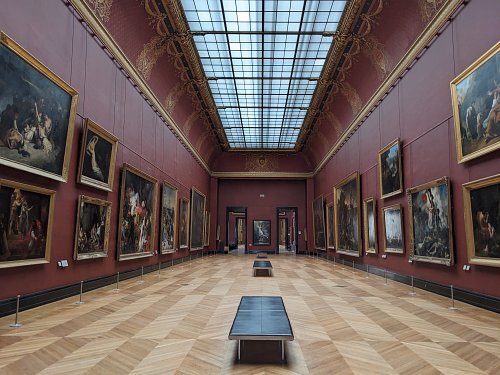
The Salles Rouges in the Denon wing get their name from the walls, painted a deep Pompeian red since 1863. Napoleon III commissioned the rooms to display monumental French paintings, and the colour was a deliberate choice — red and gold against the predominantly brown tones of 19th-century history painting. In 1969, painter Pierre Soulages contributed to a repainting that drew on ancient Pompeian pigments. The result is a series of rooms where the walls compete with the art, and somehow both win.
The paintings that fill them
These are the rooms where the Louvre keeps its largest and most dramatic canvases. Jacques-Louis David's Consecration of the Emperor Napoleon, roughly six metres high and ten metres wide, takes up most of one wall in the Salle Daru. His Oath of the Horatii and Intervention of the Sabine Women hang nearby. In the Salle Mollien, Géricault's Raft of the Medusa — first shown in 1819, depicting a real shipwreck with political undertones about the Bourbon monarchy — faces Delacroix's Liberty Leading the People, the icon of the 1830 July Revolution. Ingres is here too: the Grande Odalisque, Oedipus and the Sphinx, Mademoiselle Rivière.
History painting at full scale
The genre on display is "history painting," which in France held the highest rank among artistic categories for centuries. The subjects are classical mythology, biblical scenes, Napoleon's campaigns, and turning points in French political life. The scale is part of the point — these works were made to overwhelm, and they do. Standing in front of the Raft of the Medusa at its actual size is a different experience from seeing it in a book. The desperation on the figures' faces, the tilt of the raft, the distant speck of a rescue ship — none of that registers at postcard scale.
The Michelangelo Gallery: three centuries of Italian sculpture
Room 403 in the Denon wing was built between 1854 and 1857 by architects Louis Visconti and Hector Lefuel under Napoleon III. The gallery originally served a double purpose: official access to the Salle des États for legislative sessions, and exhibition space for sculptures during the annual Salon. Lefuel designed it with large windows on both sides, flooding the room with natural light that catches every surface of the white marble, bronze, and terracotta on display. The bold-coloured marble flooring adds to the effect — a room built to show off sculpture, not just store it.
Michelangelo's Slaves
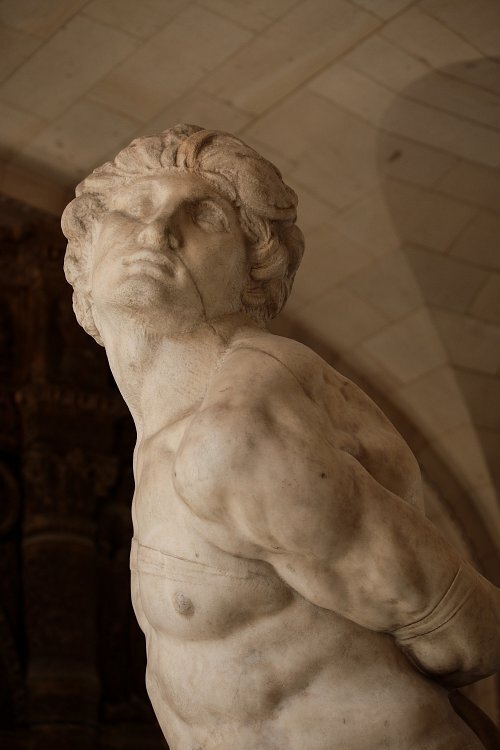
The two anchor pieces are Michelangelo's Dying Slave and Rebellious Slave, carved after 1513 for Pope Julius II's funerary monument, a project that was eventually abandoned as too costly. Michelangelo gave the sculptures to Roberto Strozzi, a Florentine exile at the French court, who passed them to King François I. From there they went to Anne de Montmorency's château at Écouen, then to Cardinal Richelieu's collection in 1632, and finally to the Louvre in 1794 after being seized during the Revolution. The journey took nearly three centuries and crossed half of Europe.
From Cellini to Canova
Beyond the Slaves, the gallery covers Italian sculpture from the 16th century to the 19th. Giambologna's Flying Mercury balances on one foot in a pose that looks physically impossible in stone. Cellini's Nymph of Fontainebleau is a bronze relief originally made for a doorway. And Canova's Psyche Revived by Cupid's Kiss captures the exact moment Cupid breathes life back into Psyche after she opened a forbidden box from the underworld — the two figures suspended between sleep and waking, carved in marble so smooth it barely looks like stone.
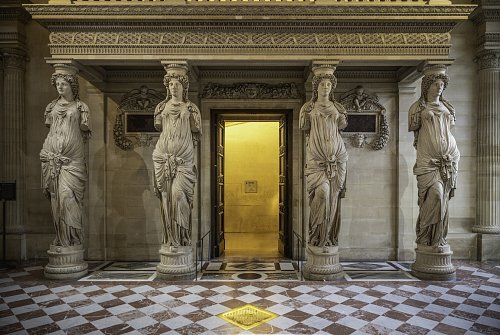
The Salle des Cariatides: at the heart of the Renaissance palace
In 1528, King François I decided to demolish the medieval fortress that had stood on the site and replace it with something that reflected the Italian Renaissance he had fallen in love with. He appointed architect Pierre Lescot in 1546, though François died the following year and his successor Henri II completed the work. The Salle des Cariatides, Room 348 in the Sully wing, is one of the most impressive survivals from that period. Four sculpted female figures by Jean Goujon, carved in 1550, hold up the musicians' gallery on their heads — an idea borrowed from the Forum of Augustus in Rome. The room was originally a royal ballroom.
From stage to museum
Molière performed here for the first time in front of Louis XIV, staging Le Dépit amoureux, L'Étourdi, and Les Précieuses ridicules. Henri IV's funeral ceremony took place in the same room in 1610. By 1692, Louis XIV was using the space to display sculptures from his collection. Napoleon connected it to adjacent galleries in 1806, and a year later the Borghèse collection, purchased from Prince Camille Borghèse, filled the room with Greek and Roman antiquities.
What stands here now
The sculptures on display include Artemis with a Doe (the Diana of Versailles), a 2nd-century BC marble copy of a 330 BC bronze. Praxiteles' Apollo Sauroktonos shows the god as a slender young man about to catch a lizard. The Sleeping Hermaphrodite surprises visitors who walk around to the other side. The Three Graces, a Silenus carrying the infant Dionysos, and the Borghèse Centaur round out a collection that turns a Renaissance ballroom into one of the finest classical sculpture galleries in Europe.
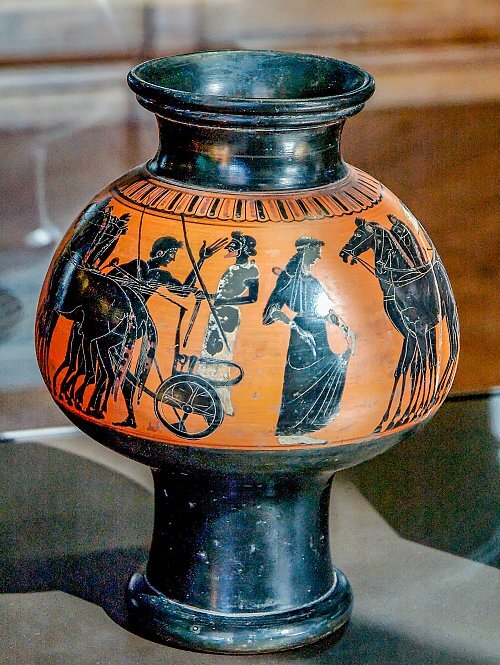
The Galerie Campana: the Marquis' Greek vases
Marquis Giampietro Campana spent decades assembling one of the largest private art collections Europe had ever seen — thousands of ancient objects and Italian paintings, many unearthed from archaeological digs he financed himself. In 1857, financial trouble caught up with him and his collection was confiscated and auctioned. Napoleon III bought the bulk of it in 1861, and the Greek pottery ended up here, in Rooms 651 through 659 on the first floor of the Sully wing. The collection spans from the 9th to the 1st century BC and covers every major Greek pottery production centre.
How the vases were made
Greek potters achieved that intense black sheen — the one that makes their work instantly recognisable — through a three-phase firing process in the kiln. The technique created contrasts between the black-painted areas and the natural red-orange clay. Designs evolved from geometric patterns in the earliest centuries to animal figures, then human forms, and finally complex mythological scenes with named characters and narrative action. One red-figure bell-krater depicting Europa and Zeus became famous centuries later for an unexpected reason: it is the image used as the watermark on Euro banknotes.
The rooms themselves
The gallery ceilings, painted between 1828 and 1833, depict French monarchs as patrons of the arts: Charlemagne, Louis XII, François I, Henri IV, Louis XIII, and Louis XIV. A panel showing General Bonaparte references the Egyptian campaign and the scientific research it sponsored. The Galerie Campana is temporarily closed, but when it reopens visitors walk through a progression from an introductory room through study galleries and into a chronological display that tracks Greek ceramic art across eight centuries.
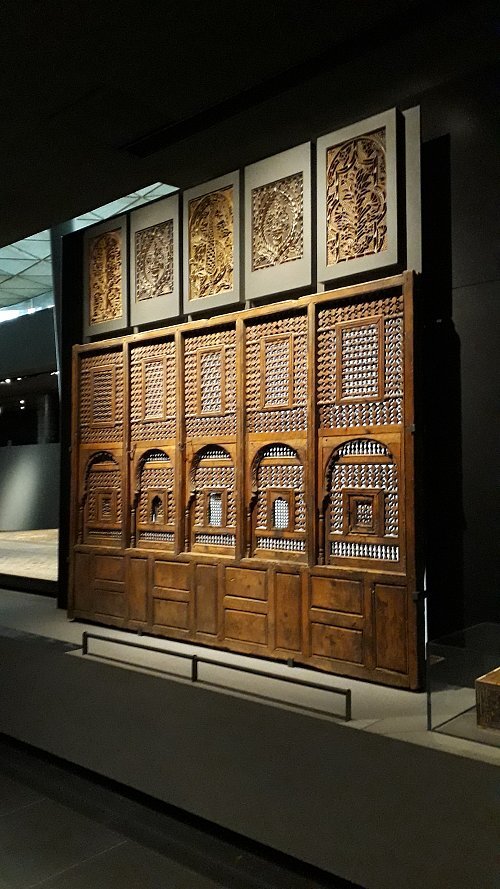
The Department of Islamic Art
The Louvre's Islamic art galleries sit in the Cour Visconti at level -2, beneath a canopy of golden glass and metal designed by architects Rudy Ricciotti, Mario Bellini, and Renaud Piérard. The undulating roof has been compared to a floating veil, a sand dune, and an Islamic latticework screen — depending on the angle and the light. The department opened in 2012 after a presidential decree established it as an independent curatorial unit, though Islamic works had entered the Louvre's collection as early as 1793 and dedicated galleries first appeared in 1893.
Three continents, twelve centuries
The collection covers the 7th century through the late 19th, with over 3,000 works from Spain to India and everywhere between: North Africa, Egypt, Syria, Iraq, Iran, Central Asia. The objects include ceramics, carved ivories, metal vessels inlaid with gold and silver, silk textiles, carpets, and miniature paintings. Among the highlights: the Pyxis of al-Mughira, an ivory box from 10th-century Córdoba. The Baptistry of Saint Louis, a brass basin inlaid with silver and gold that was actually used in French royal baptisms despite its Arabic inscriptions. A jade horse-head dagger from the Mughal Empire, set with rubies and emeralds. Sixty-three ceramic tiles from Iran depicting a poetic jousting scene at court.
Two levels, two atmospheres
The upper level sits under the canopy, with natural light filtering through the golden mesh onto the display cases. The lower level, Room 186 in the Denon wing, uses dim atmospheric lighting to display treasures from Córdoba, Cairo, Damascus, Baghdad, Isfahan, and Agra. The shift in mood between the two floors is deliberate — the upper gallery feels open and airy, the lower one intimate and focused. If you only have time for one room, the lower level tends to leave a stronger impression.
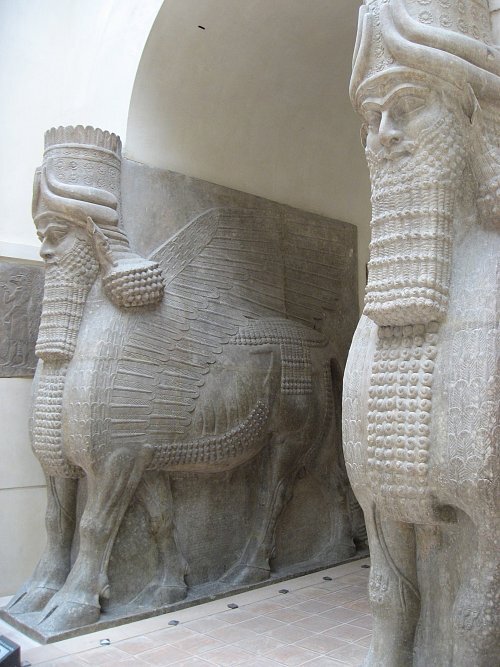
The Cour Khorsabad: the palace of Sargon II
In Room 229 of the Richelieu wing, you walk between pairs of lamassu — winged bulls with human heads, each weighing roughly 28 tonnes. They once flanked the passageways of a palace built around 713 BC by King Sargon II of Assyria at Dûr-Sharrukin ("fortress of Sargon"), near present-day Mosul in Iraq. The city was the largest in the ancient world at the time, with a palace of roughly 200 rooms and courtyards, built in under a decade using resources and labour from military campaigns. Sargon died in battle in 705 BC and his body was never recovered. His son, Sennacherib, moved the capital to Nineveh and the city was abandoned.
How it reached Paris
French archaeologist Paul Émile Botta, serving as vice-consul in Mosul, began digging at Khorsabad in 1843. The carved alabaster slabs and colossal sculptures he shipped back formed the world's first Assyrian museum when it opened at the Louvre on May 1, 1847. The discovery effectively launched the discipline of Near Eastern archaeology. The relief carvings on the slabs depict hunting scenes, court processions, and the transport of cedar wood from Lebanon. They were originally painted in blue and red, and traces of colour are still visible on some pieces.
The five-legged trick
The lamassu have a detail that takes a moment to notice: each one has five legs. From the front, the creature appears to be standing still on two legs. From the side, it appears to be striding forward on four. The fifth leg resolves the visual contradiction between the two views. A five-metre figure of a hero subduing a lion — sometimes identified with Gilgamesh — stands nearby, shown from the front rather than in the profile view that was standard in Assyrian art. The room is one of those places in the Louvre where you feel the distance in time most sharply.
The Galerie d'Angoulême: treasures of the Eastern Mediterranean
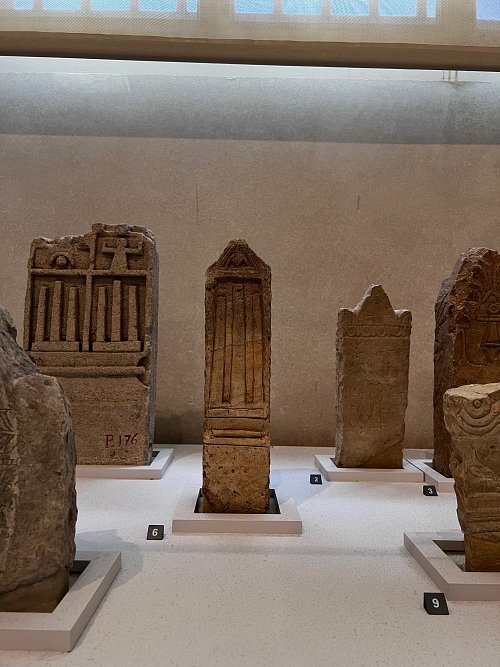
The five neoclassical rooms of the Galerie d'Angoulême, Room 301 in the Richelieu wing, were inaugurated in 1824 in the presence of King Charles X and named after his son. They originally held about 100 French sculptures from the Renaissance, most of them rescued from destroyed churches during the Revolution by Alexandre Lenoir's Musée des Monuments Français. In 1933, the sculptures were moved and the rooms were given over to Near Eastern antiquities. The collection now holds around 100,000 objects, some dating to 7,000 BC — among the oldest in the entire Louvre.
A crossroads of civilisations
The Levant — modern Syria, Lebanon, Israel, Jordan, and Cyprus — sat between Egypt, Mesopotamia, Anatolia, and the Aegean. The artefacts in these rooms reflect that position: statues and stelae, mythological texts on clay tablets, ivory boxes, golden cups, jewellery, and architectural models. The oldest piece on display is a human figure from Ain Ghazal in Jordan, dated to around 7,000 BC, still showing traces of a wig made from plant fibre and painted clothing. It belongs to the Jordanian Department of Antiquities but has been on long-term loan to the Louvre.
Objects that connect to older stories
Several pieces here reference kingdoms and figures from biblical and ancient texts. The Stele of Mesha, King of Moab, records a 9th-century BC military campaign in a dialect close to Hebrew. The Stele of Baal with a Thunderbolt, from the Syrian city of Ugarit, shows the storm god driving his lance into the earth, with leaves sprouting from the point of impact. A gilded bullock — sometimes called the Golden Calf — connects visually to one of the most familiar stories in religious history, though the object itself predates any single text.
Cour Puget and Cour Marly: French sculpture under glass
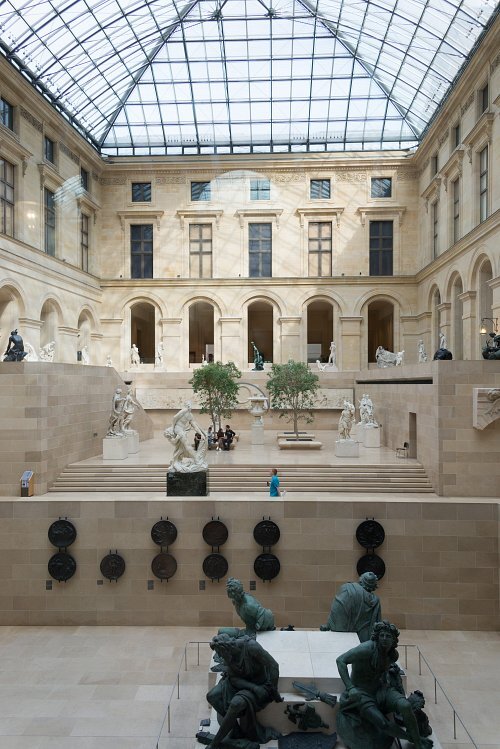
Two covered courtyards in the Richelieu wing — Rooms 102 and 105 at level -1 — hold three centuries of French sculpture under glass ceilings fitted with aluminium solar shading. The space was part of Napoleon III's wing, occupied by the Ministry of Finance from 1871 until 1989. When the ministry relocated to Bercy, architects I.M. Pei and Michel Macary converted the courtyards into sculpture galleries that opened in 1993. The glass roofs flood the rooms with natural light while keeping temperature and humidity stable, which is exactly what large marble pieces need.
The Marly horses and the royal gardens
The Cour Marly takes its name from Louis XIV's leisure residence at Marly, near Versailles, which had fountains and mythological statuary scattered through the gardens. Antoine Coysevox's Fame Riding Pegasus celebrates military victories. Guillaume Coustou's Marly Horses — two rearing stallions held back by grooms — were commissioned by Louis XV about twenty years later. Both groups originally stood at the entrance to the Tuileries Garden before being moved indoors for conservation.
Puget, Canova, and the drama of stone
The Cour Puget is named after Pierre Puget, a sculptor whose work under Louis XIV ran to extremes of expression and physical tension. His Milo of Croton, carved for the gardens at Versailles, shows the ageing athlete trapped by a tree trunk as a lion attacks — a moralising subject about the cost of pride, executed with the kind of muscular energy that made Baroque sculpture feel alive. Nearby, Pigalle's Mercury Fastening His Sandals catches the god in a momentary pause, and Barye's bronze Lion and Serpent brings the fight between two animals down to a compact, coiled composition. The courtyards cover the full arc from grand royal commissions to intimate Romantic pieces, and the natural light makes every surface read differently depending on the time of day.
The Napoleon III apartments: Second Empire opulence
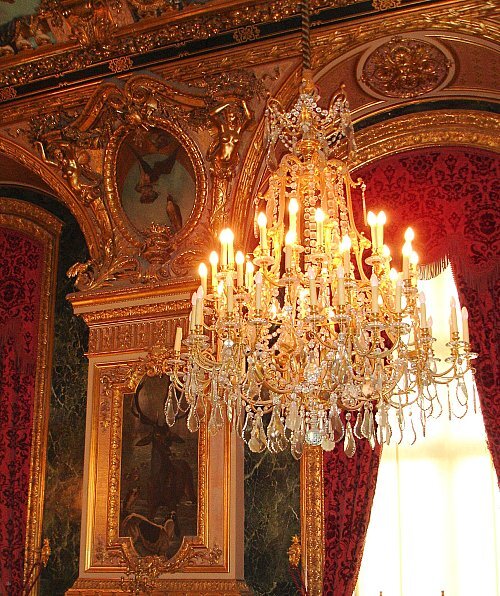
On the first floor of the Richelieu wing, a suite of rooms has been preserved exactly as it looked in the 1860s, when it served as the residence and reception space for Napoleon III's Minister of State. The apartments were created in 1861 as part of the new Richelieu wing, used by the minister and the imperial family until the fall of the Second Empire in 1870, then occupied by the Ministry of Finance until 1989. They opened to the public in 1993, and stepping inside feels like entering a time capsule of mid-19th-century excess.
What the rooms look like
The Grand Salon, Room 544, could be converted into a theatre seating up to 250 guests, with a musicians' platform installed above the stage. A chandelier with 180 lights hangs from the ceiling. The furnishings include twelve-light chandeliers in Louis XVI style, a sofa upholstered in Beauvais tapestry, a clock by Charles Crozatier, and sets of compote dish stands. The adjacent Salon-Théâtre held a portrait of Empress Eugénie. Some of the furniture had unusual designs — a two-seater called a confident, for private conversations, and a three-seater called an indiscret, for reasons that become obvious when you sit on one.
The private quarters
Behind the gilded state rooms, the minister's family lived in modestly sized rooms that looked more like a wealthy bourgeois household than an imperial residence. The contrast between the public and private spaces says something about the Second Empire itself — grand performance at the front, something more ordinary behind the curtain. The apartments hosted events ranging from formal dinners to masked balls, and the emperor and empress frequently attended.
The Galerie Médicis: Rubens and the glory of a queen
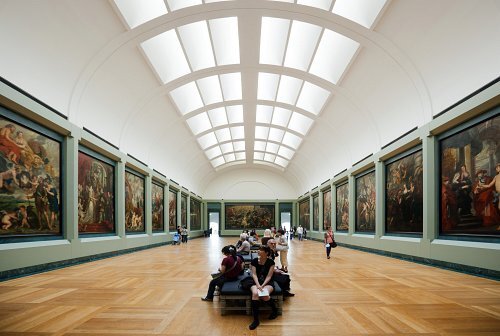
Room 801 in the Richelieu wing holds 21 canvases by Peter Paul Rubens, each four metres tall, covering roughly 300 square metres of painted surface in total. Marie de' Medici — widow of Henri IV and mother of Louis XIII — commissioned the series in 1622, shortly after returning from exile. She had built the Luxembourg Palace in Paris, modelled on the Palazzo Pitti in Florence where she grew up, and wanted a monumental painting cycle to tell her own story. Rubens, based in Antwerp, finished the entire project in four years. The queen took her time paying; Rubens eventually accepted 10 percent less than the agreed 60,000 pounds.
Politics painted as mythology
Rubens had a difficult brief. Marie's relationship with her son Louis XIII was hostile — the king had forced her into exile in 1617 when she refused to give up the regency. They reconciled in 1621, but the painter still had to glorify a queen without offending the king sitting on the throne. His solution was to weave every scene through allegory, filling the canvases with gods, nymphs, and classical references that elevated the queen while keeping the politics at arm's length. The Disembarkation at Marseille, the most famous piece, shows Marie arriving in France surrounded by Nereids and tritons — Delacroix later studied it intensely, particularly admiring how Rubens rendered water droplets on skin.
How the paintings got here
The cycle was moved from the Luxembourg Palace to the Louvre in 1790 for restoration. It spent time in the Grande Galerie and the Pavillon des Sessions before landing in its current home in the Richelieu wing, where the canvases are arranged chronologically from Marie's birth in Florence in 1573 through her escape from Blois in 1619. The room is one of the few places in the Louvre where a single artist dominates an entire gallery, and the scale of the work — 21 paintings, each taller than the average room — is hard to take in from photographs alone.
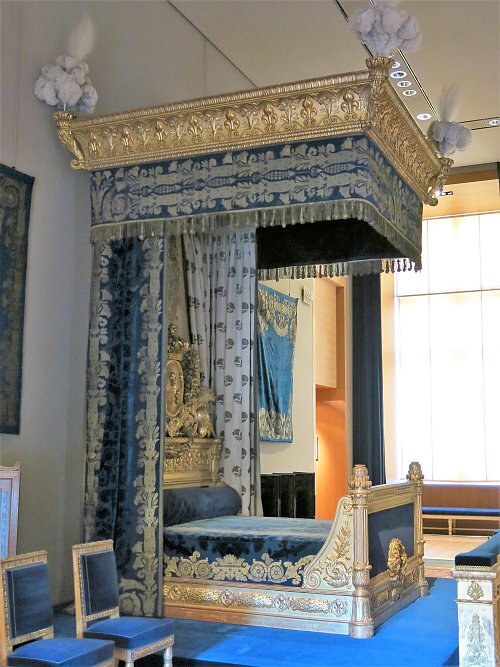
The French decorative arts: the art of living at court
The decorative arts galleries on the upper floors of the Richelieu and Sully wings are among the most overlooked sections of the Louvre, which is a shame because the craftsmanship on display rivals anything hanging on the walls downstairs. The collection covers 18th-century furniture and art objects from the reigns of Louis XIV, XV, and XVI, presented in contextual room settings rather than behind glass. You walk through recreated interiors that show how the rooms at Versailles, Fontainebleau, Compiègne, and Marly were actually furnished and used.
The workshops behind the objects
France built a network of royal manufactories during this period that produced some of the finest decorative work in European history. Les Gobelins and Beauvais turned out tapestries. Sèvres made porcelain after kaolin clay was discovered near Limoges in 1768 — France had been importing Chinese porcelain until then because nobody could figure out the formula. Lyon workshops wove silk. La Savonnerie made rugs. Cabinetmakers like Jean-François Oeben and Jean-Henri Riesener built furniture with marquetry, gilding, and mechanical elements that remain difficult to replicate today.
Things worth finding
Marie Antoinette's travel case in Room 627 is a single piece of luggage that contains writing instruments, sewing tools, and a complete toiletry set. The Clock of the Creation of the World is a mechanical marvel. Japanese lacquer cabinets sit alongside French roll-top desks with bronze mounts. Don Quixote tapestries from Gobelins hang near snuffboxes with miniature portrait lids. The rooms are quieter than the painting galleries, and you can spend time with individual objects without crowds. For anyone interested in how things were made — not just what they depicted — this is one of the strongest parts of the museum.
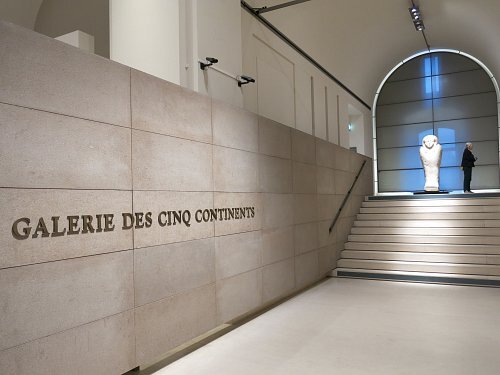
The Gallery of Five Continents
The Pavilion des Sessions, built under the Second Empire by Hector Lefuel for parliamentary use, reopened in 2025 as the Gallery of Five Continents. Architect Jean-Michel Wilmotte redesigned the interior into spacious, light-filled rooms. The gallery is a collaboration between the Louvre and the Musée du Quai Branly-Jacques Chirac, with additional loans from the Musée Guimet, the French National Maritime Museum, the French National Library, and institutions in Aquitaine, Boulogne-sur-Mer, and Nigeria.
Five dialogues across cultures
The exhibition is organised around five themes rather than geography or chronology. A 14th-century Dogon maternity figure from Mali hangs near a European Virgin and Child, linked by the universal subject of motherhood. A Roman portrait of Aelius Caesar shares a room with Vanuatu grade figures, both representing authority. Egyptian sarcophagi are placed alongside Easter Island moai heads, connecting two distant cultures' approaches to death and memory. Hindu depictions of Vishnu sit near Greek images of Dionysos. The pairings are not always obvious, and some work better than others, but the effect is to break the habit of looking at objects from one culture as art and objects from another as artefact.
Objects that stay with you
A few pieces stand out regardless of curatorial framing. The moai head from Easter Island, carved between the 10th and 15th centuries, carries the same quiet weight it would have on its original platform. The Chupicuaro female statuette from Mesoamerica is small enough to hold in one hand but detailed enough to study for half an hour. The Blue Man (Trrou Körrou), an anthropomorphic sculpture, looks like nothing else in the building. The gallery adds a dimension to the Louvre that the classical and European collections alone cannot provide.
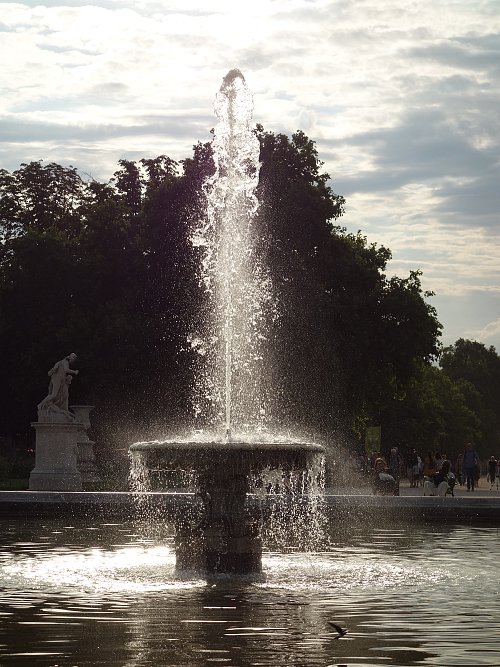
The Tuileries Garden: from royal garden to public park
The Tuileries Garden has been a part of Paris for almost 500 years. Catherine de' Medici commissioned it in 1564 alongside the Tuileries Palace, on a site outside the city walls that had previously been occupied by tile factories — tuileries in French, which is where the name comes from. In 1664, André Le Nôtre, Louis XIV's landscape architect, redesigned the entire garden. His layout survives largely intact: the Grand Carré (formal flower beds near the palace site), the Grand Couvert (eight symmetrical groves of deciduous trees bisected by the Grande Allée), and the Octogone, with its octagonal Grand Bassin and horseshoe-shaped ramps leading to raised terraces.
An optical trick and a long view
Le Nôtre built an optical illusion into the plan. From the spot where the palace once stood, four ponds appear to be the same size. They are not — the octagonal pond is actually twice as large as the round one. The perspective tricks the eye at ground level. The westward vista from the garden runs through the Place de la Concorde's obelisk to the Arc de Triomphe and, beyond it, the Grande Arche de la Défense — a line of sight that stretches over eight kilometres and connects four centuries of Parisian architecture in a single glance.
Sculpture in the open air
The garden doubles as an outdoor sculpture museum. Works from the 17th century to the present day are scattered along the paths and around the basins: pieces by Antoine Coysevox, Auguste Rodin, Jean Dubuffet, Giuseppe Penone, and Louise Bourgeois. Fragile marble originals are periodically moved indoors to the Cour Marly and Cour Puget for conservation, with replicas taking their place outside. The Louvre has managed the garden since 2005, and seasonal flower plantings now coordinate with exhibitions and cultural events inside the museum. After a few hours in the galleries, the Tuileries is the closest green space — and one of the best in Paris.