
European Sculpture, 1500 to 1800
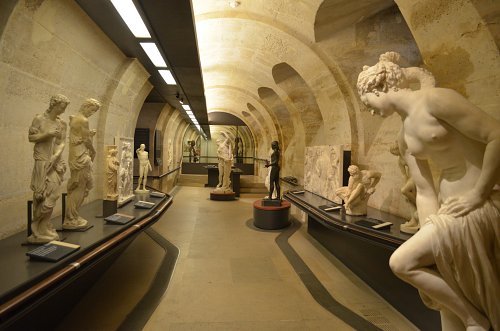 European Sculptures 1500–1800 (Denon wing, level 0)
Michelangelo's unfinished business
The two Slaves by Michelangelo are the reason most people find these galleries. The Dying Slave and the Rebellious Slave, carved between 1513 and 1516, were intended for the tomb of Pope Julius II, a project that dragged on for decades and was never completed as planned. The figures are still partially trapped in the marble, which is either a deliberate artistic choice or the result of Michelangelo moving on to other work, depending on which art historian you ask. They arrived in France in the 16th century as a gift to a French nobleman and eventually found their way to the Louvre.
The Slaves occupy their own small gallery, and the lighting is set up so you can walk around them. They're smaller than you expect if you've only seen photographs. The unfinished surfaces make them more interesting, not less. You can see chisel marks where Michelangelo was still working the stone.
Canova's kiss
Antonio Canova's Psyche Revived by Cupid's Kiss, completed in 1793, is in a glass-enclosed space nearby. It shows Cupid lifting the unconscious Psyche in a composition that works from every angle, which was Canova's point. The marble is polished to the point where it almost looks like skin. Canova was working in Rome for a cosmopolitan clientele, and the piece was commissioned by an Italian collector before being acquired by Joachim Murat, Napoleon's brother-in-law and king of Naples.
The Italian rooms
Beyond Michelangelo and Canova, the Italian sculpture galleries contain Donatello reliefs, Della Robbia glazed terracottas, and Renaissance bronzes. A Madonna and Child attributed to Donatello's workshop shows the flat, bas-relief technique he used to create an illusion of depth on a nearly flat surface. Bronzes by Giambologna and his followers include small-scale versions of compositions that exist as full-size sculptures elsewhere.
Bernini is represented by bronzes and terracotta models rather than the large marble works that fill Roman churches. These smaller pieces show his working process, the way he figured out a pose or a drapery arrangement before committing to stone.
Northern Europe
The collection also covers German and Netherlandish sculpture. Tilman Riemenschneider's limewood carvings, with their detailed faces and unpainted surfaces, are among the highlights. There's a Virgin of the Annunciation by Gregor Erhart that was originally painted and gilded. Several Flemish altarpiece fragments show the elaborate carved retables that filled churches in the Low Countries before the Reformation.
The spaces
The sculpture galleries on the Denon ground floor are arranged around two glass-covered courtyards, the Cour Marly and the Cour Puget. The European sculpture collection shares this level with the French sculpture galleries, so you can move between Italian Renaissance and French Baroque without changing floors. The natural light from the glass roofs gives the marble a different quality than the artificially lit painting galleries above, which is probably why the sculptures were put here in the first place.