
Ancient Iran, Arabia, and the Levant
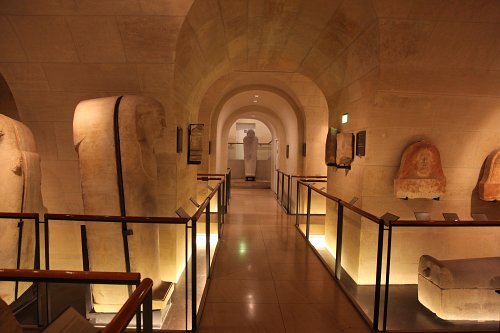 Near Eastern Antiquities / Iran, Arabia and the Levant
Susa and the French excavations
Most of what fills these rooms came out of the ground at Susa, in southwestern Iran. French archaeologists started digging there in the 1880s, under an exclusive concession from the Persian government, and they kept going for decades. The arrangement was straightforward for the era: France funded the digs, France kept the finds. The Louvre ended up with one of the most important collections of ancient Iranian material outside of Iran itself.
The objects span roughly nine thousand years, starting with painted pottery from the 5th millennium BC and running through the Achaemenid Persian Empire and beyond. They're displayed on the ground floor of the Sully Wing, in rooms that tend to be less crowded than the Egyptian or Greek galleries upstairs.
The Persian Archers
The most immediately striking pieces are the Frieze of Archers from the Palace of Darius I at Susa, dated around 510 BC. These are life-size figures made from glazed bricks in vivid color, mostly blues and yellows. They were part of a long processional wall in the palace, and the Louvre has a substantial section reassembled on the gallery wall. Each archer carries a bow and quiver, and the detail on their robes is precise enough to pick out individual patterns in the fabric. The glaze has held up remarkably well for something 2,500 years old.
Near them, a massive capital from the Apadana, the great audience hall at Susa, sits on the floor. It's a bull-headed column capital, the kind that once held up a ceiling over a space where the Persian king received visitors. Standing next to it gives you a sense of the scale Darius was working at.
Before Persia
The earlier material is just as interesting, if less monumental. Painted ceramics from Susa I, around 4000 BC, show geometric and animal designs that are sophisticated for their date. A beaker decorated with an ibex whose horns curve into enormous spirals is one of the best-known pieces from this period. There are cylinder seals from the proto-Elamite period, small carved stones used to roll impressions into wet clay, each one a miniature world of animals and figures.
The Elamite civilization, which preceded the Persians in southwestern Iran, is well represented. A bronze statue of Queen Napir-Asu from around 1340 BC weighs nearly 1,800 kilograms and is one of the largest surviving bronze pieces from the ancient Near East. It was found at Susa in 1903. The head is missing, but the body and the crossed hands have a formal gravity that comes through even without a face.
The Levant and Arabia
The galleries also cover material from the eastern Mediterranean coast and the Arabian Peninsula. Phoenician ivory carvings, Cypriot pottery, and objects from the ancient cities of Byblos and Ugarit fill several rooms. A group of gold bowls from the royal tombs at Byblos dates to around 1800 BC. They're small, thin, and decorated with hunting and mythological scenes that show Egyptian influence, which makes sense for a city that traded heavily with Egypt.
From Arabia, the collection is sparser but includes objects from pre-Islamic kingdoms in what is now Yemen and Saudi Arabia. Funerary stelae, inscriptions in South Arabian script, and small bronze figures give some sense of cultures that remain poorly known outside specialist circles.
Why these rooms matter
The Susa material alone would justify a visit. The French concession meant that for decades, major archaeological finds from one of the ancient world's most important sites went directly to Paris. That arrangement wouldn't happen today, and there are ongoing questions about whether some of the material should be returned. In the meantime, the galleries offer one of the most complete presentations anywhere of Iranian civilization before Islam, from painted pots to palace walls.