
The History of Louvre
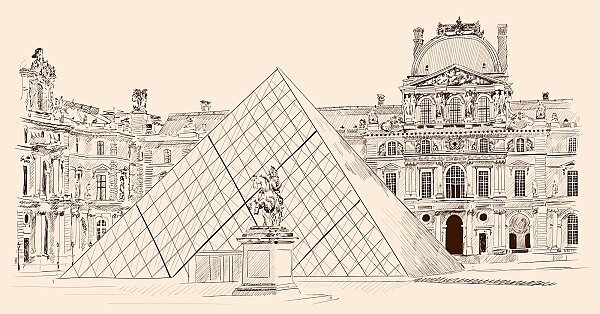
The process that led to the creation of the Grand Louvre as we see it today has taken almost two centuries: a constant effort not only to improve its user-friendliness, but above all to present as complete an overview as possible of human artistic achievement, from the Neolithic to modern times.
Of the seven departments that make the Paris complex one of the largest and most comprehensive museums in the world, three are entirely dedicated to the ancient world: Oriental Antiquities and Islamic Art; Egyptian Antiquities; Greek, Etruscan and Roman Antiquities. In these collections, important Sumerian sculptures, colossal Egyptian statues and famous Greek and Roman marbles are on display for us to admire, as well as everyday objects such as Egyptian women's toiletries, Greek crockery and mass-produced Roman terracotta figurines: the art of the ancient world, but also the craftsmanship. The oldest finds from the East are those from Mesopotamia of the late Neolithic period; from the Hellenic world, the slender, stylised Cycladic marble figurines of the Copper and Bronze Ages; while the earliest Egyptian artefacts date from the end of the 4th millennium BC. The Ancient World sections of the Louvre, however, follow the complete evolution of the cultures represented in all their phases, both protohistoric and historical. In fact, the layout of these collections constantly reflects the changes in history over the centuries, allowing us to interpret the spirit of the times.
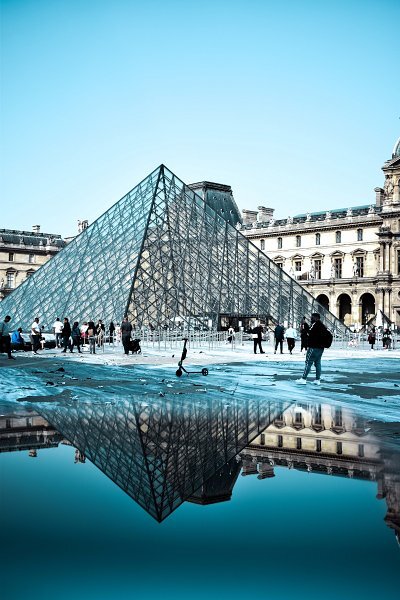
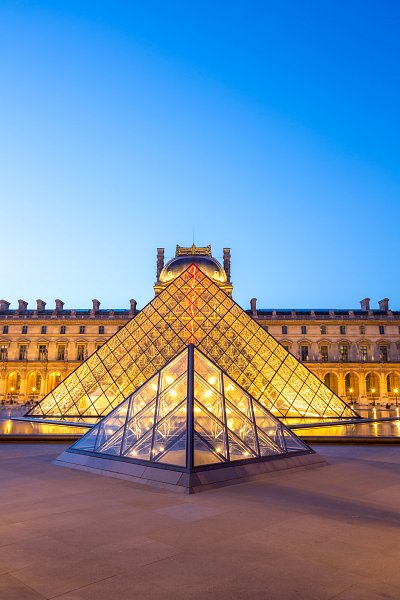
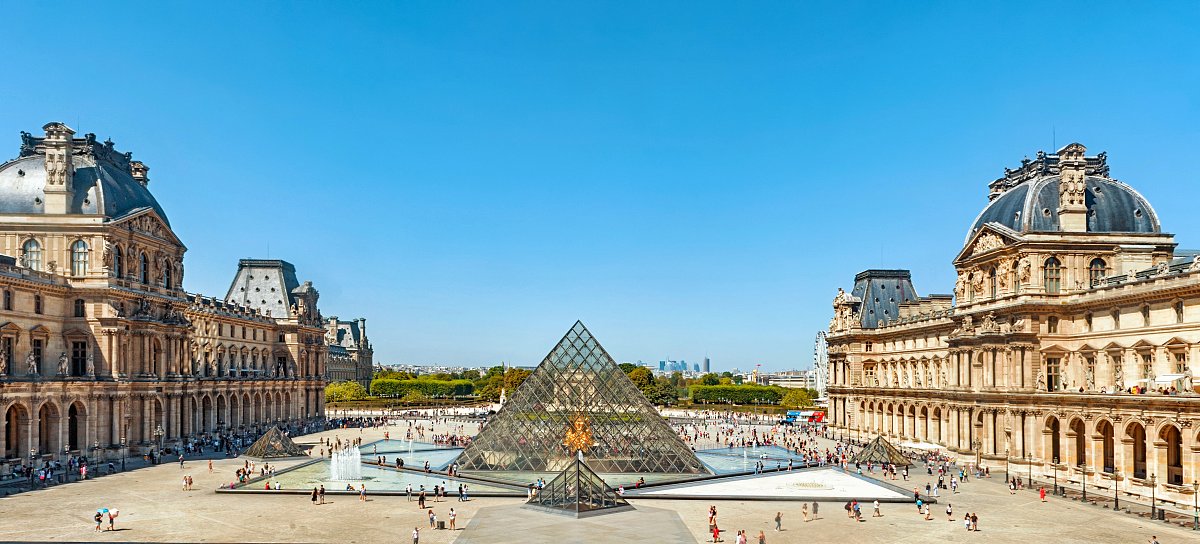
While its antiquities collections are influenced by human history, the history of the Louvre &mdash the Louvre building &mdash is determined by the history of France. It is no coincidence, therefore, that access to the museum's collections is via a descent into the moat, originally filled with water, which surrounded the huge bastion of the medieval fortress and was uncovered during the construction of the new monumental entrance, the pyramid designed by the architect Ieoh Ming Pei in the great Napoleon courtyard. Visitors then enter the pyramid, a symbol of eternity and grandeur, to descend into the subterranean chambers of history (the antiquities collections), but also to admire the medieval foundations of the building, which was constructed at the end of the 12th century.
The Louvre palace later became a royal residence, the palace of Charles V, and was enlarged and transformed during the Renaissance at the behest of Catherine de' Medici. Later, under the influence of the Enlightenment, one wing, the Grande Galerie, became a place frequented by artists and craftsmen who not only copied the paintings but also studied the splendour of the ancient nudes to learn about anatomy. The palace was not originally built as a museum; it was only during the Enlightenment, when Diderot called for a museum for all French people, that the project took shape. This was completed in 1793 with the creation of the Musée Centrale des Beaux-Arts, which was constantly enlarged with the spoils of the revolutionary troops and renamed the Musée Napoléon in 1803.
Through the purchase of individual works and entire collections on the antiques market, the original but haphazard art collection of the kings of France began to grow, and the Louvre acquired its characteristic role as a mirror of contemporary culture and history, reflecting Napoleon's policy in Italy and his desire to glorify his family. The Borghese collection, consisting mainly of ancient marble statues, and the Campana collection, a veritable treasure trove of painted Greek vases found in the necropolises of Etruria, were acquired with this in mind.
The return of works stolen by Napoleon during his military campaigns left noticeable gaps in the museum's heritage, but these were soon filled. In the 19th and 20th centuries, the development of the antiquities collections took a number of different paths: excavations, scientific expeditions and planned acquisitions were organised to complete the documentation of the many aspects of ancient cultures that had not yet been represented. The goal that has always inspired the curators of the three departments has been that of completeness, the desire to present all aspects of a culture; and although the collections began as a collection of unique pieces, they soon sought to document other aspects of ancient life, such as ceramography, coroplastics, small toreutics and goldsmithing.
Champollion's studies and work, combined with the will of Charles X, contributed to the creation of the world's first Egyptian museum; Botta's excavations in the East brought to the Louvre the exceptional Assyrian reliefs from the palace of Sargon II at Khorsabad and led to the creation of the Assyrian Museum in 1847; The scientific research of Renan, Dieulafoy, De Morgan and Parrot brought to Paris unique works such as the statues of Gudea, the friezes from the palace of Darius I in Susa and the statues from the city of Mari in Syria. In the mid-19th century, the success of the study of antiquity was demonstrated by the creation of the first Greek museum, where works were displayed in chronological order, and by the organisation of the first archaeological exhibition dedicated to the reconstruction of the Macedonian tomb of Pydna, excavated by a French mission, in the octagonal room of the Louvre itself, following its success at the Universal Exhibition of 1862.
More recently, there have also been exceptional events, such as the gift of a metope from the Temple of Zeus at Olympia by the Greek government to the French government in gratitude for its support of Greece against the Ottoman Empire. The Venus of Milo and the Treasure of Boscoreale were also donated to the museum, while exchanges with other institutions brought important works such as the Lady of Auxerre to Paris. This long process of creation has resulted in a unique complex for the history of the ancient world: three magnificent archaeological museums united in a single, vast and constantly evolving museum.
THE LOUVRE, MUSEUM OF KINGS AND PEOPLE
Like a living organism, the Louvre has grown gradually and progressively over the centuries; although periods of intense development have been followed by moments of pause, its collections continue to expand.
Originally, almost nothing we see today was planned: the museum's current form is the result of a historical evolution that has gradually determined its appearance. Everything that appears inside and outside the vast museum is the result of tastes, choices and circumstances, sometimes accidental, sometimes linked to the actions of kings and rulers, but also of the French people and their artists.
The opening to the public in 1725 of the Salon Carré for the exhibition of paintings by the Royal Academy of Painting and Sculpture (since known as the 'Salons') was a fundamental moment for Parisian and European culture, as the Salons became a showcase for the national artistic scene, a place of reflection and inspiration for painters and sculptors of many generations. It is probably thanks to the opportunity to enjoy the works collected in the halls of the Louvre that many new artistic movements were born and developed in France, destined to influence the rest of Europe.
The gradual expansion of the collections of paintings and sculptures also led to the emergence of a new way of thinking about art history. As early as 1784, when Louis XVI, in the spirit of the Enlightenment, decided to create a museum in the Grande Galerie, the painter in charge of organising it, Hubert Robert, was faced with the difficult problem of choosing the works to be exhibited. Until then, this question had not arisen because all the paintings and sculptures in the Louvre came from art collections assembled over the centuries by French monarchs for the sole purpose of enriching their residences: they were not intended for the general public, much less for education.
Most of the masterpieces in the Louvre today were part of the personal collections of the kings of France, starting with Francis I, who was a passionate patron of the arts and surrounded himself with a large number of works by the great Italian and European masters, even inviting the artists themselves to his court to lend it splendour and prestige. The first important nucleus of his collections was later joined by the major acquisitions of Louis XIV, the Sun King, and the equally large and prestigious collections of Cardinal Mazarin and the banker Jabach.
The first sovereign to imagine a new and different way of managing and enjoying the royal collections was Louis XV, who began to think of the Louvre as a possible 'Palace of the Muses': a place where the great masterpieces of the French collections could be systematically collected, preserved, handed down to posterity and shown to the public.
In reality, the Louvre did not become a real museum until the French Revolution, when it was transformed from a 'royal gallery' into a 'national gallery' and began to receive a huge number of new acquisitions, mostly the result of the wars waged first by the Republic and then by Napoleon. The intention was to make the Louvre a symbol of France's power and cultural superiority. Especially under Napoleon (who gave the museum its name during his reign), the most important works of art in Europe from all periods, from Antiquity to the Renaissance and the 17th century, were gathered in Paris.
With the Restoration, the dismantling of the Musée Napoléon allowed the plundered countries to recover some of the stolen works, but many of them remained in Paris, where they can still be admired today. From then on, the museum's policy of expansion was uninterrupted, and by the time the Louvre became a national museum in the 19th century, its fame was already enormous and its greatness universally recognised.
Today, the museum covers an area of 55,000 square metres and houses 30,000 objects in seven collections, which are visited by around 5 million people a year. There are sections devoted to decorative arts, Egyptian, Greek, Etruscan and Roman antiquities, French, Italian and Spanish paintings, and Italian drawings.