
French Painting, 1600 to 1850
 Paintings / France / 1600–1850 (Sully wing, level 2)
Where the quiet paintings live
The Sully Wing's second floor holds French paintings from the 17th through mid-19th centuries. These rooms don't get the foot traffic of the Italian galleries downstairs, which is a shame, because the collection is arguably the Louvre's most complete in any single national school. You can follow French painting from the early Baroque through Romanticism without leaving the floor.
The galleries are arranged roughly by period, starting with the 17th century. The rooms themselves are smaller and more intimate than the grand galleries of the Denon Wing, which suits the scale of many of the paintings. Not everything here is monumental. A lot of it is domestic, observational, quietly brilliant.
The 17th century: La Tour, Le Nain, Poussin
Georges de La Tour painted candlelit scenes where a single flame does all the work. His The Cheat with the Ace of Diamonds hangs here: three card players and a servant exchanging sidelong glances while one of them palms a card. The light picks out the silk, the cards, the expressions. La Tour was forgotten for two centuries after his death and only rediscovered in the 20th century. Saint Thomas, acquired more recently, shows the same stripped-down use of light against dark.
The Le Nain brothers (Antoine, Louis, and Mathieu) painted peasant scenes with a gravity that their contemporaries reserved for religious subjects. Peasant Family in an Interior has no narrative drama. People sit around a table. A boy plays a flute. The dignity of the painting is in what it doesn't try to do.
Nicolas Poussin and Claude Lorrain represent the classical tradition. Poussin's The Arcadian Shepherds (Et in Arcadia ego) is here, with its famous contemplation of death amid an idealized landscape. Claude's harbor scenes and golden-hour landscapes influenced painters for the next two hundred years.
The 18th century: Watteau, Chardin, Fragonard
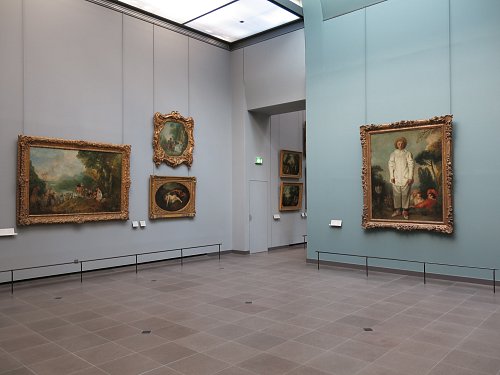
Antoine Watteau's Pierrot (also called Gilles) is one of those paintings that changes every time you see it. A figure in a white clown costume stands facing the viewer with an expression that's hard to read. Behind him, other commedia dell'arte characters go about their business. Watteau invented the fête galante genre and died of tuberculosis at thirty-six.
Jean-Siméon Chardin painted still lifes and kitchen scenes with a kind of attention that makes a copper pot or a piece of bread look like something worth staring at. The Ray, an early work showing a gutted skate fish on a table, is both beautiful and slightly disturbing. Much of the Chardin collection came to the Louvre through the La Caze donation of 1869, which also brought in works by Fragonard, Rembrandt, and Watteau.
Jean-Honoré Fragonard painted faster and looser. His works here tend toward the playful and erotic, though The Bolt has an intensity that goes beyond flirtation. The contrast with Chardin is useful: two painters working in the same century with completely different ideas about what painting was for.
Into the 19th century
The later rooms carry the story through the Revolution and into the early 19th century. You'll find transitional works that bridge the Rococo and Neoclassicism, and canvases from the generation of painters who worked during and after the Napoleonic era. The shift in subject matter is visible: allegory gives way to contemporary history, and the palette darkens.
The Sully paintings collection complements what you'll find in the Richelieu and Denon wings, which hold earlier French painting and large-scale works respectively. Together they make up the most comprehensive survey of French painting anywhere, and the Sully rooms are the part most visitors miss.