
"The more you look at this painting, the more complex it becomes, and the richer it gets."
 "The more you look at this painting, the more complex it becomes, and the richer it gets."
In what context does this painting belong within the oeuvre of Anthony van Dyck?
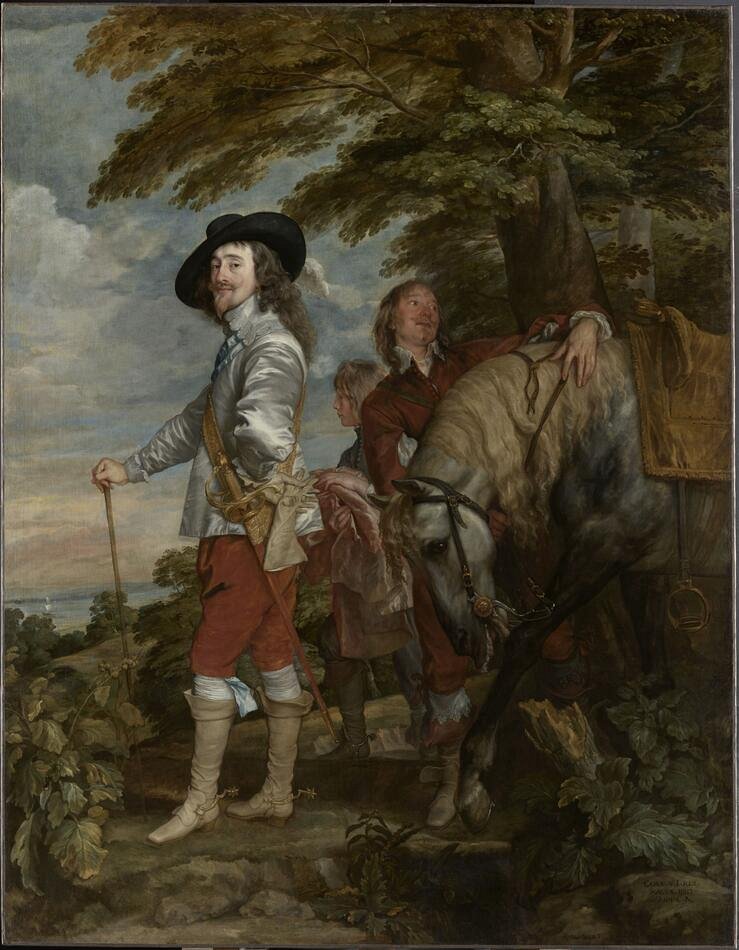
Van Dyck’s most famous work has also become the best-known image of an English monarch. The history surrounding the portrait has an air of mystery since it is known to have entered the French Royal Collection under Louis XVI (1775), but there is no record of when or how it arrived in France. Based on the evidence available, it is believed that the painting originated from the palace of the exiled King James II of England around 1700. Since no records exist about the painting after its completion in the late 1630s until 1700, it is remarkable that such a large painting (271 x 211 cm) went missing from history for so long, only to reappear in France.
In the catalogue raisonné, you assert that this portrait by Van Dyck may be considered the most exquisite in the museum. What characteristics render this work so remarkable in your view?
Yes, indeed, that's an important question. The amount of artistry that has gone into this work by Van Dyck is remarkable; he only made one sketch for it! Van Dyck painted the king in its entirety without a single section being redone and again demonstrates his great degree of skill as an artist and a remarkable ability to create an incredible sensation of lightness. However, the most outstanding and interesting thing about the painting and how impressive the painting is; the subject of the painting and the aura of uncertainty surrounding him are subtle but overwhelmingly there.
Could you please clarify your statement?
The theme demonstrated in this image of a king at a hunt seems incongruous because there are no dogs, guns, prey or active participants. There seem to be three possible explanations for this discrepancy; first, perhaps the intent of the artist was to signify something other than "hunting," second, Charles I was known to be a very enthusiastic hunter with little regard for distance when pursuing game of any kind and third, hunters often spend extended periods on lengthy hunting expeditions which require them to stop for rest at various times during these expeditions; the moment of rest was conveyed by the artist.
What methods can be employed to ascertain this?
Although men have generally failed to communicate effectively through narrative expression, they have found that the horse has fulfilled an equal or greater role than any man could. Various interpretations have been put forward about the horse lowering its head to give respect to the king. While this shows unique creativity, it is inaccurate. Horses generally do not exhibit signs of submission or loyalty after having run a long distance with their rider and usually just remove the saliva from their mouth on to their front leg. This painting shows Van Dyck's vast understanding and experience as a hunter and animal handler. Thus, it is more than a basic portrait; rather it is an illustration of how a multidimensional narrative can evolve. The work includes outward motion through kinetic movement, indicating the artist's recognition of activity outside of the canvas through sight, viewing distance, and how one sees things from different viewing angles.In what manner?
If the entourage of a king during a royal procession were limited to three people, then that would be unimaginable. Thus, one can logically surmise there are many more members of an entourage located just outside of the frame of this painting. This is another example of Van Dyck's brilliance; he creates a vibrant and noisy gathering of royal attendants using visual "reference," while at the same time portraying a painting that is still regal, stately and peaceful. Van Dyck implicitly depicts the whole royal domain and everything connected with it, and not just the king. The reason why kings go hunting is to ride throughout their kingdom's land. As evidence of this assertion, we can observe a ship located near the upper left corner of the image at sea serving as a veiled reference to the Royal Navy's power. The painting is composed of distinct visual elements and also contains several extrinsic references that provide context for understanding the significance of Britain.Could you please provide some instances?
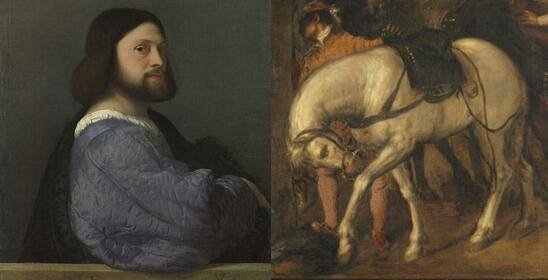
Charles I wanted to have a painting like that of Titian from his own time period, so he had an excitingly abstracted view of the King in his commissioning of Van Dyck. The king’s elbow is a very obvious reference to Titian’s representation of Barbarigo, plus the way the horse stands has a very strong reference back to Titian’s rendering of the Three Wise Men. Therefore, it is not surprising that Charles I commissioned Van Dyck for his work because he wished to have something of similar merit to that of Titian’s works.
What are some examples?
Two elements seem to clearly reference Italian paintings. First, the king’s jutting elbow – a dramatic pose that unambiguously echoes the Portrait of Gerolamo (?) Barbarigo by Titian. Second, the position of the horse alludes to another work by the same artist: the Adoration of the Magi. It’s no coincidence, really, that it’s often said that Charles I tapped the Titian of his time in commissioning Van Dyck.
 Titien%20-%20r%C3%A9f%C3%A9rences%20italiennes
From where do these Italian allusions originate?
Van Dyck has had extensive training from several different courts of Italy before he began working for the Habsburg's court in Brussels. Van Dyck is beginning to change the tradition of painting in England as well as to participate with other artists in changing that tradition, even though his work is completely on the European continent.
Does this also indicate Van Dyck's ambition to assess his abilities in comparison to those of his contemporaries?
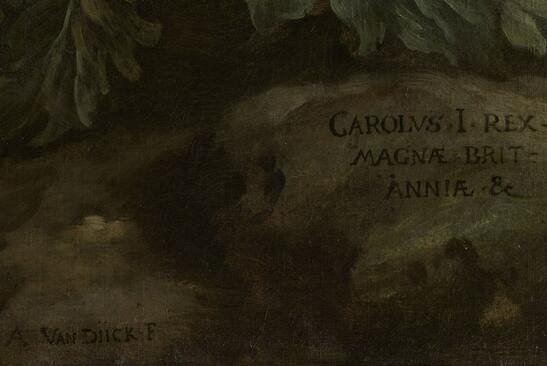
Van Dyck served as a royal artist. However, the purpose of the royal office is to convey messages internally and externally to other courts; therefore, portraits of the royal family (royalty) are competing for attention (likely) with other important royal portraits. This competition was an area of great interest for Van Dyck and eventually became an obsession for him.
In what manner?
Because of his great talent, Van Dyck faced difficulties due to being a child prodigy and being capable of so many different things, like Picasso at 15. The production of beautiful portraits by Van Dyck became a chore because he had to fill an overwhelming amount of requests for portraits from royal courts across Europe. In the end, because of the number of requests for portraits he had received, he became overwhelmed with the number of requests he had received.
 D%C3%A9tail%20signature%20C1%20VF1_0
Based on your analysis, his careful focus on the human form contributes to his artistic ability. Is this evident in the portrait of Charles I?
The artwork follows a specific standard, adhering to set human proportion standards; the dimensions of a king's head measured one eighth of their full-size body with all other physical body features being established and augmented by precise ratios. The mathematical proportionality used to create all these figures is a significant reason for the realism and elegance that emanate from Van Dyck's figures. The apparent fluidity, ease, and casualness to everything at the surface level of the work is actually carefully planned and calculated. The composition contains multiple levels of meaning and depth, becoming more complex as you look at it longer due to the layers of significance that are added. This gives a high level of richness, making it an example of a true masterpiece.
What prompted the recent conservation treatment of the painting?
While there was no immediate danger to the painting when we began conservation two years ago, it had reached such poor visual quality that a solution was needed. The varnish had oxidized and turned the painting yellow and dark.
Was the conservation treatment a significant undertaking?
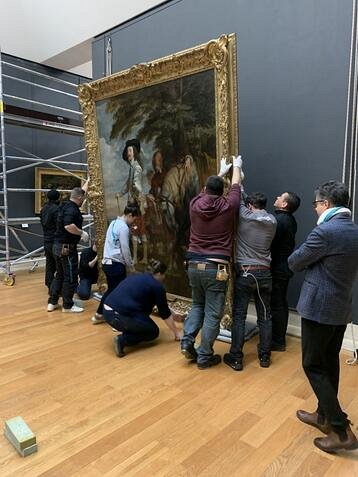
During the twelve months that the project spanned, four conservators (Luc Hurter and Jean-Pascal Viala, serving as "support" conservators; Cécile Des Cloizeaux and Frédéric Pellas, responsible for the pictorial layer) came together. I would like to extend my sincere appreciation and praise to each of them. Even though the duration of the conservation process might imply difficulties with the treatment, this was merely due to the size of the artwork. In addition to being a large piece, the conservation treatment team did not experience any technical difficulties that required new methods of treatment.
What is your assessment of the final outcome?
The results amaze me. I'm filled with happiness; how it touched me! There is joy in every part of this restoration, which has restored new life to every part of us as well. We see the original Van Dyck at the best he has ever done. There are parts of this piece—the king's face and the blue-ish gray sky—that have been lost forever but are now visible again. We are reminded of the supersized abilities of this man and how well he painted animals, landscapes, and basically anything his mind could think up; he had a gift that was absolutely unreal. This piece also includes the foundations of what would later become the basis for 18th-century English landscape painting.
 Photo%20montage%20C1%20V1
Is it not true that this portrait of King Charles I is not the sole work by Van Dyck making its return to the Louvre?
Another example of Van Dyck's English period is about to be made public! The Portrait of Anne Carr, Lady Russell, Countess of Bedford will be coming out soon. It has not been seen in many years and represents a true revival, as it has not been shown in my lifetime. When we found the portrait while organizing the catalogue raisonne of Van Dyck's work, it had been assumed to be a version of the original, or from the studio. When I saw the painting, I could not help but be impressed by it, and thought it worthy of conservation treatment, assuming that the attribution would likely change. I was right: this painting is a significant work from the period of King Charles I's reign. If all goes according to plan, the newly restored painting will be on display at the end of February, and I am looking forward to discussing it in more detail.