
Three new papyrus documents in the Louvre collection
 Three new papyrus documents in the Louvre collection
Captain de Reverseaux (1788-1852) was an officer in the French Navy during the Restoration and later during the July Monarchy. De Reverseaux most likely received the three manuscripts in 1823 from Bernardino Drovetti, then French consul-general of Egypt at Alexandria. During Drovetti's time, he possessed an enormous collection of Egyptian artifacts that he acquired while living in Egypt. The manuscripts remained within Captain de Reverseaux's family for over two centuries prior to their placement in the Louvre.
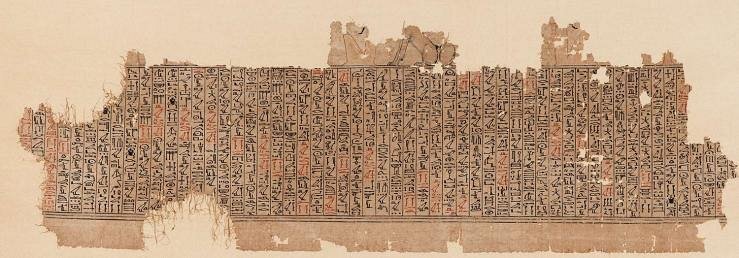
The 'Reverseaux II Papyrus': An Egyptian Book of the Dead.
This papyrus fragment was taken from one of the compilations of texts that ancient Egyptians carried with them into the afterlife to help them defend against any dangers they might encounter there; specifically, it contains Chapter Det containing a list of questions (written in red) with fragments of beautiful decorated vignettes. The writing is in cursive or simplified hieroglyphic script. It dates from sometime between 1300 and 1200 B.C., and belonged to a scribe by the name of Paherypdjet.
The 'Reverseaux III Papyrus': Correspondence from a Master of Vessels
This papyrus document was once a roll of paper; however, it was preserved after being unrolled and has a letter from the boat master named Belpunait to the scribe named Ramose during the reign of Ramses II (approx. 1279–1213 BC). The script of the letter was elegantly written in hieratic, a script that resembles glyphs in an individualized, cursive format. About 50% of the letter had formal salutations before the body of the letter that instructed Ramose to not remove the mast from his boat. Another interesting aspect of this letter is that parts of the Egyptian administration would often overlap or interfere with each other’s activities. The reverse side of the letter contains the names of both the sender and the recipient as if the papyrus were a modern envelope.
The 'Reverseaux I Papyrus': An exceptional collection of written works by scribes.
Among the three papyri, the Reverseaux I Papyrus is the most important. It was first bought when it was only partially rolled and stood about 70 centimeters tall. After its conservation work, its height is now 222 centimeters tall. Although it contains two scrolls which have been glued together since ancient times, part of the beginning of the scroll has been lost. The Reverseaux I Papyrus is written by at least three different scribes and has a hieratic script with red punctuation; this is typical for literary papyri in this period. Furthermore, the Reverseaux I Papyrus contains some passages that were considered to be essential material for someone who was about to enter the long and successful career of administration. Anthologies, otherwise known as "miscellanies", were a popular type of written document during the time of the New Kingdoms ruled by the Egyptian pharaoh Ramses, who ruled from 13 BC until 11 BC. A vast assortment of anthologies have existed in various collections throughout Egypt. However, until now, the Louvre Museum did not contain many anthologies within its collection. The following is a description of six different types of text found on this scroll:The conclusion of a prayer dedicated to the deity Amun-Ra of Karnak, imploring his assistance during a time of necessity, is also documented in a papyrus housed in the British Museum, London.
- Two other documents that contain admonishments to a student that have become disillusioned with studies and require reshaping his behavior. The term "the ear is on your back" in the second example shows that knowledge could only be obtained through physical punishment. The word "sebayt" in Egypt means both teaching and punishment. In Egyptian culture life was viewed as hierarchical with the most powerful figure at the top followed by those less powerful until the bottom.
- A prayer to Amun-Ra has recently been discovered. The prayer uses an unusual new way of speaking to Amun, comparing him to both the ocean and the air around us. The purpose of this prayer is to be closely connected to Amun in the deepest part of our being. Because this particular prayer contains many errors or misunderstandings that do not happen in the rest of the manuscript, such a prayer would have been extremely rare at that time in history.
- The warnings against the rogue have been well-documented. Even though he technically qualified as a student, he chose to fight, drink, and chase after loose women rather than study and learn, which obviously caused great concern for moralists—much to the delight of today's readers.
- A letter attributed to the scribe Hori is considered an important classical work of the time period and is included in anthologies of this era. In this work, the scribes used excessive exaggeration and many elaborate techniques to criticize themselves in a humorous way. This new version, however, has a new author whose name has been changed to Panehesy, which means "the Nubian" in Egyptian. Almost as if said author was trying to illustrate through humor that his writings could also be comedic because they were attributed to a non-Coptic person and enemy of Egypt.
- The final text of the leather sandals that were made for the cobbler is an example of a faux delivery note that has no other delivery document available to reference. The piece was placed at the end of the manuscript to remind students of the administrative processes that they would undertake on a daily basis in the performance of their work.
- There are still other things on the back of the papyrus where there are examples of how to write letters and there is also one complete sentence. There are also regions on the back that have been patched with pieces of papyrus signifying that this document was used for many years. Overall, this collection is remarkable and provides new evidence for ancient Egypt with regard to its history and both its literature and other forms of popular culture.
The back of the papyrus bears traces of exercises involving written characters and even one sentence. A number of papyrus strips have been glued to the back in an attempt to repair the manuscript, thus proving that it was in use for a long time. The set as a whole is remarkable and sheds new light on ancient Egypt, its history and its literary and popular culture.