
Masterpieces of the Louvre Museum
Robert Badant: Masterpieces of the Louvre
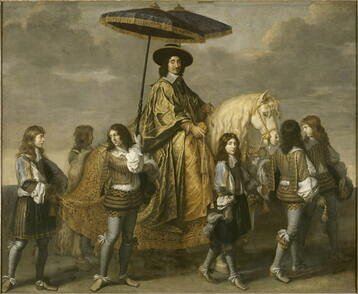
Author and lawyer Robert Badant, a former Attorney General, was invited to visit the Louvre in 2005. He provided us with his interpretation of Charles Le Brun's (1660-1661) painting, *The Minister of Séguy*.
 Le_chancelier_Seguier.JPG
'Power and glory': this phrase resonates as we look at the fine painting by Charles Le Brun showing the grand procession of Chancellor Seguier, with foot squires (1660-1661). In what solemn occasion was this painting made? It is said that this was made when Louis XIV returned to Paris after marrying the Infanta Maria Theresa, an event that was celebrated in Saint-Jean-de-Luz on August 26, 1660. There was no need to include more dignitaries to show absolute royalty. As the first among the great officers of the kingdom, the Chancellor sealed official acts and councils in the absence of the King. Although the King could remove the Seals, the Chancellor was irremovable from his office, symbolizing the stability of the Monarchy.
In the picture, we see the Chancellor placed at the front line, in his best clothes, on a white horse. The squires are there to show how big the Chancellor is, how great his group is, and so how great his King is. The old and fuzzy face of the Chancellor gets less attention from the painter than the eye of his horse, the gold cloth on his robe, and the black velvet of his hat. This is how Le Brun makes clear the full power of his boss, Louis XIV, in a work of art that tells a story. Let's give the painter a big round of applause for this work of art, which makes the splendor of the Sun King clear through the riches around Chancellor Seguier.
Robert Badinter is a notable figure.
A notable work housed in the Louvre, created by Anselm Kiefer.
This week, the artist Anselm Kiefer, who established a permanent installation at the Louvre in 2007, brings forth the two renowned paintings of Rembrandt from the Louvre’s collection: Self-Portrait with an Easel and Meditating Philosopher.
This week, artist Anselm Kiefer, author of a permanent décor at the Louvre in 2007, brings together two of Rembrandt’s masterpieces from the Louvre collection – Self-Portrait with an Easel and Meditating Philosopher.
 330842117_218224893926511_6784299454257676040_n.jpe
In Rembrandt's Autoportrait au chevalet, the artist stands in front of his easel, facing the viewer or a mirror. A palette is held in one hand, partially hidden by the stretcher line parallel to the canvas. The other hand holds a brush; its position is the most important aspect of the second painting by Rembrandt, as it will be used to focus the viewer's attention on the head of the artist, assuming the picture ends on the right side of the stretcher. For now, it is enough to say that the importance of the diagonals that intersect the canvas will be discussed further in the second Rembrandt painting analysis; for the time being, the artist's head coincides with the intersection of the two diagonals, assuming the picture ends on the right side of the stretcher.
The eyes are what set all Rembrandt's self-portraits apart. They have held me since I was a child. Time and again, on visits to museums—even when I was a schoolboy and looked at the self-portrait in Karlsruhe, wanting to draw it there and then—I found myself drawn into those eyes. They are a gentle vortex, an aperture closing, full of the tension of a mystery that both reveals and hides at the same time.
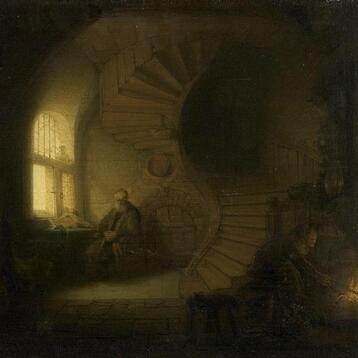
Le philosophe en méditation. Let me place the second, smaller one of these paintings on view beside the other, since that is the way I saw them, one after the other, at the Louvre. Their tie is not of theme but of shallower, more formal relations. The round right eye in the self-portrait is taken as a roundness mark for the entire painting of the philosopher. It is on this circle, at the point of intersection of two diagonals, that we see the face of the philosopher. Here brightness, opposed to darkness at the edges, lights up that whole circular form. The form is later revealed to be the size of the eyeball in the self-portrait; only, here, the darkness of the eye becomes a bright spot, a center of the circle, and so brightness is an element inverted to obscurity.
I metaphorically cut the corneal surface of the artist’s sight and I see a very interesting mystical architecture of opening and closing eyes. At the convergence of the two diagonals is the head of the philosopher, where he remains calm in a very dynamic movement around him. There is a big spiral staircase inside the picture, and there is a door to the right of the philosopher, leading to a room behind. This way, the philosopher can think about up and down, heaven and earth, perhaps traveling the Seven Heavenly Palaces of Merkaba mysticism, which Rembrandt knew. And, furthermore, the presence of fire in the lower right corner of the composition would suggest a connection to Athanor, the alchemical furnace.
I am not sure how far you have come with me in the cornu of the artist's self-portrait. But it is important to realize that a picture goes beyond its mere materials or intellectual allusions; it comes into being within us through our perception, including elements that the artist may not have fully thought of. So it stays alive and keeps on changing.
A remarkable work housed in the Louvre, created by Robert Wilson.
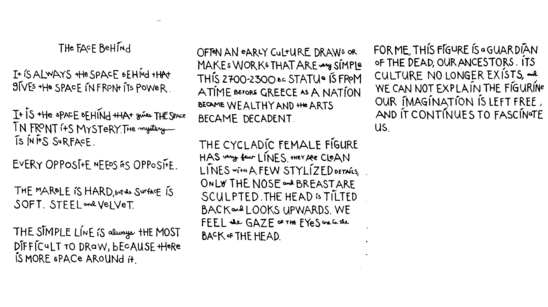
In 2013, the artist Robert Wilson, who was a guest at the Louvre, made drawings that responded to a Cycladic sculpture.
 bob-wilso
Le visage intérieur
C'est invariablement la zone située derrière qui confère sa force à la zone située devant.
L'espace situé derrière confère un aspect mystérieux à celui qui se trouve devant. Cette énigme réside dans sa surface même.
À chaque force opposée correspond son homologue.
Le marbre possède une dureté, et pourtant sa surface présente une douceur, semblable au contraste entre l'acier et le velours.
Michelangelo's Captives or the Division of the World
The reader will find a conversation between an ex-Director and CEO of the Louvre and a young curator, both apparently unversed in practical experience of sculpture; however, they have good knowledge of the "slaves" that Michelangelo chiseled five centuries ago from monumental blocks of marble. The visible chisel strokes provide evidence of the technique: one can determine the width of the chisel and the strength of the sculptor's arm that wielded the hammer. This is because there was no disruptive mechanization in the 16th century; there was unity between a man and his tool in the process of creation. The scholar, lacking practical experience, defines his gesture in a vocabulary of materiality, often metaphorically speaking, to articulate his intentions. Yet for the craftsman, it is as if the misapplication of what defines his craft comes from a diminishment of his own creative universe. The Greeks, in their prime, as Virgil notes, held all toil in contempt and left it for their slaves to work while free men exercised the body and the mind in games and in learning. The philosophers would have it that all labor is degrading to a free man; poets, that it is a divine blessing to be idle—"O Meliboeus, this idleness is the gift of god." Craftsmen, therefore, who did not spend their time in idleness (by which was meant the hearing of plays, the practice of athletics, or the pursuit of politics) were held in the same low esteem. The slave, considered in this context, is an instrumentum vocale, essentially a speaking tool and therefore cannot afford to be idle for his being is purely material and consists only in productive actions. Does that also make him a slave? For Michelangelo, then, what is the meaning of being a worker?Mr. Martin Szekely
A work of exceptional artistry by Miquel Barceló housed in the Louvre.
In 2004, the painter Miquel Barceló, who was a guest at the Louvre, offers his reflections on Luis Egidio Melendez’s Portrait of the Artist (1746). This piece is presently featured in the exhibition Les Choses.
The painter Miquel Barceló, a guest of the Louvre in 2004, gives his insights on Luis Egidio Melendez’s Portrait of the Artist (1746). His work is currently displayed in the exhibition Les Choses.
This self-portrait was painted at the age of thirty and is considered a major work by the leading painter in the Spanish Bodegón genre. It is the only known work of his that contains human figures, though x-ray examinations show that there are figures beneath several of his most highly regarded still-life compositions.
Luis Egidio Melendez was born of a family of painters and miniaturists, and he was brought up from his childhood like a young lion, which nature intended to become a Messi in painting, and destined him for the service of the Casa Real.
The self-portrait located in the Louvre depicts him at a time of life when all possibilities lay ahead. Full of ambition and vitality, he displays his drawing with the same flourish as a bullfighter brandishes his capote. The youthful Luis Egidio exhibits a remarkable fearlessness...
His artwork comprises one-quarter portraiture, one-quarter trompe-l'œil, one-quarter drapery, and one-quarter shadow.
Soon after, he was expelled from the little San Fernando Academy in Madrid, and for the rest of his life, his career would be marked by a series of rejections and disappointments in his quest for the post he had longed for since childhood: that of the king"s official painter.
He was granted commissions, though some were almost insulting, like the one to create 44 paintings of the products of Spain. Putting his resentment aside, he continued to create one masterpiece after another.
Few scholars who have considered the Melendez oeuvre note that his painting shows almost no technical development; from the beginning, he used a very careful technique that stayed the same over his whole career. But if you look more carefully at the edges of the tables that are always in his bodegóns, you can see a change: first, these edges are nice and straight, but over time, along with the pile of rejection letters, they get dinged and nicked. Just as Billy the Kid marks the handle of his gun for each kill, so our artist marks his experiences for each setback.
Melendez reaches modernity through a distinct path compared to Velazquez or Goya. Like Yasujiro Ozu, he positions his perspective remarkably low — aligning it with that of a child or someone seated on the ground, nearly touching his subjects, each of whom is also imbued with their own history.
We record the impacts, the cracks, and the rough and abrasive surfaces.
His self-portrait, which opens this body of work, is the perfect, unblemished fruit that has never known hail, wasps, or the inevitable scuffs of living.
Miquel Barceló
A significant work that is in the Louvre's collection, created by the artist Yan Pei-Ming.
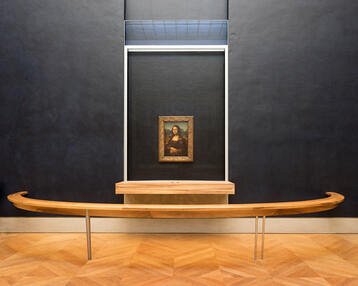
The artist Yan Pei-Ming, who conceived The Funerals of Monna Lisa in 2009, first showed the work at the Louvre. It now belongs to Louvre Abu Dhabi's collection, where it is currently on view. Yan shares his views on the Monna Lisa.
 illustration
During my early years in China, the Mona Lisa was a widely recognized image. Leonardo da Vinci enjoys considerable fame there, and no artist's creation has achieved the level of popularity as that of the Mona Lisa portrait. It serves as both a myth for artists and a celebrated legend. The first artwork that visitors desire to see at the Louvre is the Mona Lisa; if one has not viewed it, one cannot claim to have visited the Louvre. Leonardo dedicated four years to the creation of this portrait, which exemplifies the ideal of portraiture—it encompasses everything: the hands, the smile, the hair, and the landscape. It functions like a window. When I received an invitation to the Louvre, the Mona Lisa was immediately at the forefront of my thoughts. At that time, I exhibited in the Denon rooms, situated behind the actual Mona Lisa, akin to a shadow. Rather than simply creating a gray shadow, I incorporated intricate details. The landscape depicted behind the Mona Lisa has been the subject of extensive scholarly research; I found myself deeply immersed in her imagined realm.
Yan Pei-Ming
A remarkable work housed in the Louvre, created by Candida Höfer.
In 2009, the photographer Candida Höfer, invited by the Louvre, offers her insights on the Guan Yu okimono.
Walking through the Richelieu Wing in search of motives, I paused at a vitrine where, quite incongruously, porcelains were displayed with what I took to be Netsuke. A particular interest in Japanese culture made me stop for a moment longer as my eye was caught by a little figure in the corner, which I soon saw was an okimono.
The figure wore what I interpreted as a skeptical expression, probably unhappy at the rate at which I had gone through the Museum. On closer scrutiny, I saw that indeed the details were fine and this convinced me to look at it more attentively. The stance seemed that of a man ready to make a challenging statement. At the same time I noticed that he was hiding an object behind his back, a weapon. Yet he seemed to be a kind person, almost teasing me about my fear, and that made him smile.
Candida Höfer
A work of art from the Louvre created by Xavier Veilhan.
These fragile containers go back almost 3,500 years. Amazingly, the heather rattan remains in perfect condition, stored in the dry sand. This flexible material takes on a three-dimensional shape that can hold, gather, and organize different things. As a useful object, it is still made and used today. Making it involves doing the same knot over and over manually. This is an early sign of the industrial and digital ages. I am touched by the simplicity, the ordinariness, and the familiarity of this object, which has now prompted me to consider what lies beyond the visible.
Mr. Xavier Veilhan
A piece of work to remember housed in the Louvre, created by the artist Chéri Samba.
In 2015, the Louvre invited artist Chéri Samba to share his impressions of Arcimboldo’s Winter.
There are many artists whose work I consider excellent, due to their great talent for imagination and inspiration. To make and show a piece, you must first think of it or be inspired. I also like the way they try to say their ideas with great skill. A big one is the great Giuseppe Arcimboldo.
I first saw the work of Giuseppe Arcimboldo in a book in Brussels. I could not believe what I saw; I read the book again and again, and still, I could not understand what was so amazing about it. The pictures were beautiful. I decided to make my own Arcimboldo, just like I had made one for another great artist, whose name I will not reveal, inspired by the strong effect.
I was ready to take as much time as would be needed to prove that I could reproduce such an outstanding work. My father always told me to aim high, to be with great people, so that I could grow and avoid the kind of stagnation that makes one an old child. Following his advice, I challenged myself to paint at a level close to his. And so, I allowed myself to repaint—one more time after that first one for the unnamed artist—a work by Arcimboldo: Winter from the series of the four seasons. I called it Stupor.
Arcimboldo is, in my opinion, one of the most important intellectuals in the realm of painting, and he therefore stands as an ideal example to follow, while, of course, maintaining our inherent diversity. I would like to thank the Louvre and all those who have inspired me to express my admiration for Arcimboldo.
Chéri Samba.
A remarkable work housed in the Louvre, created by Isabelle Cornaro.
In 2015, the artist Isabelle Cornaro, who was a guest at the Louvre, offered her insights on a figurine from the Parthian-Babylonian period.
The artist Isabelle Cornaro, guest of the Louvre in 2015, comments on a Parthian-Babylonian figurine.
I first met this amazing figurine in 1993 during my studies at the Louvre, and I thought about it enough to really connect with it.
The museum received it as a donation from Pacifique-Henri Delaporte, a collector and consul at Tunis, Cairo, and Baghdad during the heyday of the second French colonial empire.
The figure, frontal and reserved, has an extreme auratic quality: it shows a very sophisticated play between the streamlined silhouette and the soft, diffuse whiteness of alabaster. The mind of the observer keeps oscillating endlessly between the outline and the material, returning to the outline again. Should one wish to focus on the jewels at the navel, around the neck, and in the hair, they will form an abstract landscape crossing the body with striking geometric precision. This seems to give her an otherworldly presence, embodying both divine and animalistic traits.
In the tomb in which she was found, there is the Babylonian Parthian goddess of love and war, Nanaya, who is described as having "justice walking constantly" at her side. Equally captivating are the nations with which she is associated: Akkad, Sumer, Babylon, and their ancient cities Ur, Uruk, Susa, and Nineveh, situated at the border of Iraq and Iran.
Isabelle Cornaro.
A remarkable work housed in the Louvre, created by Mark Manders.
The artist Mark Manders, who was a guest at the Louvre in 2015, offers his insights on Leonardo's Virgin and Child with Saint Anne.
The artist Mark Manders, guest of the Louvre in 2015, comments on Leonardo’s Virgin and Child with Saint Ann.
Virgin and Child with Saint Anne, attributed to Leonardo da Vinci, dating from 1501 to 1519.
When I was around 20, just starting out as an artist, I managed to save enough to get to Paris and spent four days doing nothing but staring at the Louvre. It really became such a big part of my art and me as a person. The artwork ‘Virgin with Child with Saint Anne’ was just amazing.
It's a very nice piece by Da Vinci, a good expression of love from a higher point of view. Every time I look at this painting, I can't help but think that the lady in the back and the one in the front are actually the same person both making a gesture of love.
The idea of incompleteness altered my attitude toward the work. I would now focus on creating open spaces.
Mr. Mark Manders A well-known work in the Louvre made by Monique Frydman.
In 2013, the artist Monique Frydman, who was a guest at the Louvre, gave her view of the painting by Sassetta, The Virgin and Child surrounded by six angels.
A masterpiece of the Louvre by Monique Frydman
The artist Monique Frydman, guest of the Louvre in 2013, comments on Sassetta’s The Virgin and Child surrounded by six angels.
Virgin and Child with Six Angels attributed to Sassetta. Panel from the Borgo San Sepolcro Polyptych.
It was within the restoration studio of the Louvre that I made my initial discovery. I behold her—the Virgin, this elusive figure—so near, still vibrant alongside the artist who rendered her for us only yesterday, Sassetta. The restorer tenderly revived the brilliance of this blue, delicately applying her fine brush to it—the divine blue of the mantle.
She stands in front of us, surrounding us with her glowing beauty, a young and modest woman in a blue dress, showing gentleness and self-assurance, amazed within her golden light. He is the Child, full of love for her. Together with them are the six angels playing music, their smiles taking us on the wings of their tunes. Happiness is heard inside a golden box. Yet this picture had a very sad future: the Polyptych was taken apart, its boards taken away, and some of them broken. Lately, work to put the Polyptych back together has been going on in many places, though slowly.
It is my own mistake to want to put it back together and remake it by myself. As a painter today, I find it bold to face the great work whose not being here has changed it into just a dream! My "Sassetta Polyptych" was shown at the Salon Carré of the Louvre, put across from the Florentine masters of the 13th, 14th, and 15th centuries.
Monique Frydman.