
The Medieval Louvre
 Medieval and Renaissance Decorative Arts (Sully wing, level -1)
The Castle Before the Castle Before the Museum
The Louvre didn't begin as a museum. It was a fortress. Then it was a royal palace. Only after the Revolution, when the revolutionary government decided that art belonged to the people rather than kings, did it become a museum. But beneath the museum, beneath the palace, beneath the galleries, are the remains of the original fortress. You can walk along the medieval moat. You can see the foundation of the keep tower. Philippe Auguste built this place in 1190. He was the King of France, and he needed a fortress to protect his capital, Paris. He built it on the banks of the Seine, a spot with strategic value.
The fortress Philippe Auguste designed was militarily efficient. Thick walls surrounding a central square. A keep tower in one corner for additional defense. A moat around the entire structure. It was impressive for its time and immediately practical. Wars happened frequently enough that having a secure stronghold near the capital wasn't optional. It was necessary.
For nearly two centuries, the fortress served its purpose. Then, in the 14th century, King Charles V decided he wanted a palace more than a fortress. He kept the old structure but modified it extensively. He built a new keep tower, elevated and more sophisticated than the original. He added living quarters. He created a space where a royal court could actually live and conduct business. The medieval fortress became a medieval palace.
For about two hundred more years, the site was inhabited and modified. Monarchs added and changed things. The Valois family, the Medici queen Catherine de Medici, kings who wanted to expand and update. But France kept moving its capital and its court to other palaces. Versailles eventually became the royal residence of choice. The Louvre fell into partial disuse, though various people lived in it and it served occasional purposes.
Then, during the 16th and 17th centuries, another transformation. The Louvre was entirely redesigned as a palace, a grand artistic and architectural project. The medieval fortress was essentially erased, or rather, built over. The new structure was classical, designed according to Renaissance and Baroque principles. The original walls and keep remained but became invisible, buried beneath new construction.
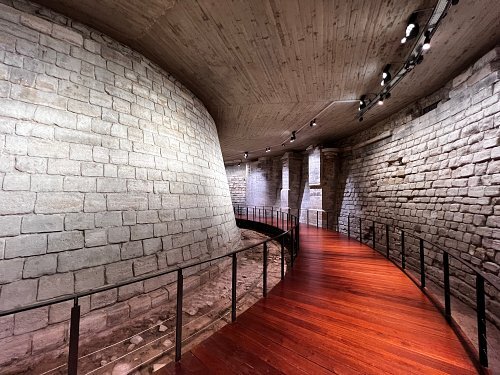
This is where the gallery begins. In the 1980s, during the Grand Louvre renovation project, which was meant to transform the entire museum, architects decided to excavate beneath the museum. They wanted to find and preserve the medieval Louvre. The excavations happened between 1984 and 1985. And they found it. The original moat of Philippe Auguste's fortress. The base of the keep tower. The foundational walls. Stones from the 12th century.
The medieval gallery now exists as an archaeological site exposed to museum visitors. You walk along paths that follow the moat line. You see the original stone walls. You can touch them (well, you're technically not supposed to, but the stones themselves are ancient and the contact is part of the experience). The keep tower's base is massive. Standing in front of it, the thickness of the walls registers immediately. This was built to last and to withstand attack. The craftsmanship is visible. The stones were carefully dressed. The builders knew what they were doing.
Objects from the medieval excavations appear throughout the gallery. Pottery fragments. Tools. Coins. A gilded helmet of Charles VI, a later king, was found during the excavations. It's ornate, decorated with enamel work, clearly a luxury object for royal use. The helmet was likely lost or abandoned during some historical event. It survived by accident. But surviving, it becomes a physical trace of a specific person, a specific era.
The medieval Louvre wasn't monumental or famous. It wasn't designed by celebrated architects. It was built by craftspeople using the knowledge they had. Philippe Auguste hired the best engineers he could access. They built structures that lasted eight hundred years. That's the achievement that underlies the grand historical narratives. Things survived.
Walking through this gallery is disorienting because you're inside history rather than outside it looking in. You can stand in the moat. The moat is real. Water once filled this space. It was a defensive feature. It was also a physical boundary. If you were inside the fortress, the moat protected you. If you were outside, it separated you from safety.
The keep tower rose higher than the surrounding walls. It was a refuge. If the fortress walls were breached, people could retreat to the keep. It was a bunker and a symbol simultaneously. Visible from a distance, it announced the fortress's presence. Standing near its foundation and looking up at its base, you sense the original intention. This thing was built to be impressive. To intimidate. To protect.
The layers of history visible here are almost excessive. Medieval fortress. Renaissance palace. Baroque expansion. 19th-century imperial palace. 20th-century revolutionary museum. Each period built on what came before. Some layers are visible. Some are buried. The excavation brought the medieval layer back into the light after centuries of being covered. It's a peculiar form of archaeology—not a distant site but the foundation of one of the world's greatest museums.
The gallery is quiet. The modern Louvre above is full of crowds. Down here, surrounded by medieval walls, the pace feels different. You're looking at stones that were quarried, shaped, and laid in place in the 12th century by people who are long dead. You're looking at the physical remnants of decisions made eight hundred years ago about how to structure and protect a building. The materials lasted longer than the people who created them. The intention lasted longer than the immediacy. That's what the medieval Louvre reveals.