
Mesopotamia and the Ancient Near East
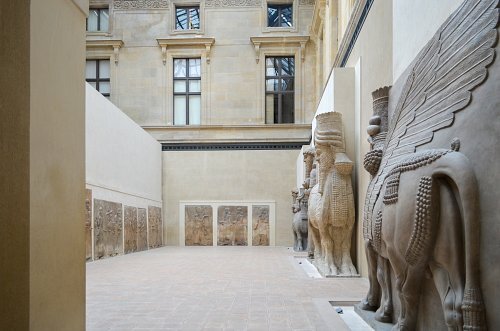 Mesopotamia and the Ancient Near East (Richelieu wing, level 0)
The Code of Hammurabi and Mesopotamian Law
The most famous object in the Mesopotamian galleries is the black basalt stele inscribed with the Code of Hammurabi, dating to 1792-1750 BC. It's not the oldest law code—there were earlier ones—but it's the most complete and the one that survived as an intact monument. The code begins with Hammurabi's authority granted by the sun god Shamash and ends with curses against anyone who damages the stele. In between: 282 laws covering everything from commerce to injury to family relations. "If a man put out the eye of another man, his eye shall be put out"—the famous eye-for-an-eye formula appears here, though the code also recognizes economic compensation as an alternative. The text is carved in cuneiform and reads in spiraling columns around the stele. It's a work of both legal and sculptural achievement.
Monumental Guardians: The Winged Bulls of Khorsabad
Dominating the Richelieu ground floor are colossal limestone lamassu—human-headed winged bulls—carved in the 8th century BC from Sargon II's palace at Khorsabad in Assyria. These sculptures stand 4.5 meters tall and weigh hundreds of tons. Lamassu were apotropaic figures meant to guard entrances and ward off evil. The bulls have five legs: four visible from the side create the illusion of standing, while five are visible from the front, creating a visual trick that confuses the viewer's perspective. The human faces are carved with idealized Assyrian features: long curled beards, cylindrical crowns. The museums at the Louvre acquired these after French archaeologist Paul-Émile Botta excavated Khorsabad starting in 1843. Botta's work was among the earliest scientific excavations in the Middle East and led to the rediscovery of Assyrian civilization.
Writing and Early Administration
The Sumerian galleries hold thousands of cuneiform tablets from Tello (ancient Girsu), dating from the 3rd millennium BC. These are not literary masterpieces but administrative records: inventories of barley, lists of workers, contracts. Yet they're invaluable. They show how the Sumerians organized large agricultural societies, how they taxed, how they recorded debts. The script itself evolved from pictures—the word for "head" originally looked like a head—to abstract wedge-shaped marks pressed into clay with a reed stylus. Cuneiform was difficult to learn and became the tool of professional scribes, which meant literacy was power. The tablets reveal the mechanics of ancient civilization: bureaucracy, transaction, the daily business of maintaining order across communities.
Gudea's Pious Portraits
Gudea statues from Lagash (22nd century BC) appear throughout the galleries—short, squat figures of a Sumerian ruler seated or standing in formal poses. Gudea ruled as a governor and left nearly 30 surviving statues, making him one of the most documented individuals of early Mesopotamia. The statues are made of hard dolerite stone and show him wearing a fleeced cloak and holding attributes of piety: hands clasped, or holding an architectural plan on his lap. The inscriptions often refer to his devotion to the god Ningirsu. Unlike Egyptian statues, which tend toward idealization, Gudea's figures have a somewhat stubborn, individual quality—pursed lips, a particular nose shape, a specific body type. They feel like real portraits, though that wasn't necessarily the intention. Each statue probably stood in a temple, prayer figures serving the god on the patron's behalf.
Reliefs from Palace Walls
The later Assyrian period produced narrative reliefs carved into limestone or alabaster for palace walls. The Louvre has fragments from Nineveh and Khorsabad showing hunting scenes, military campaigns, religious ceremonies. In these panels, figures overlap in registers (horizontal bands), and scale indicates importance: the king is largest. Archers aim at lions. Chariots wheel across battlefields. These weren't decorative—they were propaganda, permanent records of the king's power and piety. The reliefs often include cuneiform inscriptions running alongside the images, combining visual narrative with text. The technique of carving into stone reached extraordinary sophistication: individual hairs on beards are incised, muscles show anatomical precision, and the spatial composition is often dynamic despite the flat medium.