
Italian Painting at the Louvre
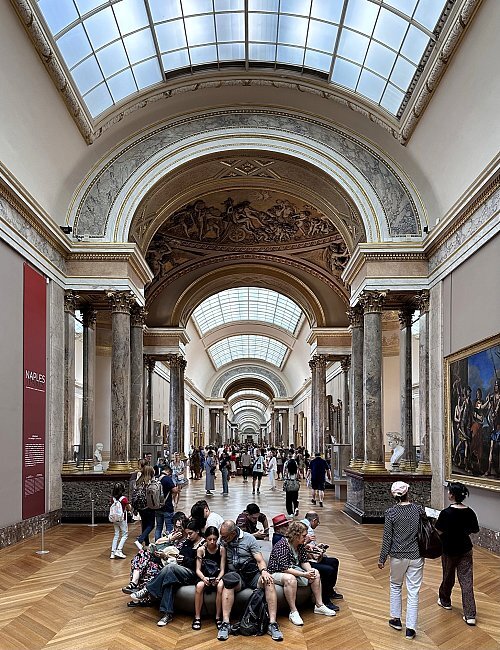 Italian Painting at the Louvre (Denon wing, level 1)
The Mona Lisa and Its Myth
Leonardo da Vinci's Mona Lisa (c. 1503-1519) is the most famous painting in the world, yet it's not the largest work in the Louvre, nor the most technically accomplished, nor the most historically important. It's famous because of the subject's expression—that ambiguous smile—and because the painting has been stolen, vandalized, and reproduced infinitely. Lisa Gherardini was a merchant's wife, not a royal or mythological figure. Leonardo painted her at a small scale, perhaps 77 by 53 centimeters, on a poplar panel. The sfumato technique—the soft, almost smokeless transitions between light and shadow—creates a mood of mystery. The background is a strange landscape that doesn't quite correspond to the figure's scale. Leonardo worked on this painting for years, maybe decades, tinkering, adjusting, never quite finishing. It traveled with him when he accepted an invitation to France from François I in 1516. Leonardo brought it, or it was brought after his death, and it remained in French royal collections. It's in the Louvre because of that history.
Veronese's Wedding at Cana
Paolo Veronese's Wedding at Cana (c. 1562-1563) is the largest painting in the Louvre, measuring 6.7 by 9.9 meters. It's not a small, intimate scene but a vast banquet with over 100 figures. Veronese has interpreted the biblical wedding where Jesus turned water to wine as a Venetian aristocratic celebration. Musicians play instruments. Servants carry platters. Dogs run beneath tables. The color is brilliant—reds, yellows, blues, golds—and the composition is a horizontal parade of activity that pulls the eye across the surface. There's a dog in the lower left that's painted with as much care as the principal figures. The painting is also famous for having been nearly destroyed: the Nazis tried to burn it during World War II, but it survived. It dominates the Salle des États where the Mona Lisa also hangs, yet many visitors never notice it, fixated on the smaller, quieter painting by Leonardo.
Leonardo's Virgin of the Rocks
Leonardo painted the Virgin of the Rocks twice, once in Paris (the Louvre version) and once in London. Both show Mary, John the Baptist as an infant, the Christ child, and an angel in a grotto surrounded by rocks. The painting uses the sfumato technique to create an almost unearthly atmosphere. The figures are connected by gesture and glance rather than explicit narrative. Leonardo was interested in pyramidal compositions—the figures form a stable triangle—and in the relationship between human figures and natural space. The painting is small, intimate, introspective. It's not a scene of action but of presence, of being together in a mysterious space. Leonardo's drawings for the painting show how carefully he worked out every gesture.
Raphael and Lyrical Grace
Raphael's La Belle Jardinière (c. 1507) shows Mary, the Christ child, and the infant John in a landscape. The title translates to "the beautiful gardener." The composition is pyramidal, with Mary at the apex. The color is warm and luminous. Raphael's work represents a different sensibility from Leonardo's: where Leonardo is mysterious and searching, Raphael is clear and harmonious. Raphael died at 37, yet his output was enormous. He managed workshops, took commissions from popes, created designs for tapestries. His style became the basis for academic training for centuries. Students copied Raphael to learn proportion, composition, and the relationship between figure and background. The Louvre has a substantial collection of Raphael's work, including drawings and cartoons.
Caravaggio's Violent Beauty
Michelangelo Merisi, called Caravaggio (1571-1610), brought street realism into religious painting. His Death of the Virgin (c. 1604) shows Mary's body laid out, attended by apostles, with a bare bulb or candle illuminating the scene. The model was allegedly a drowned prostitute from the Tiber. The painting shocked viewers: Mary was supposed to be spirited to heaven, not left as a corpse. Caravaggio's other work at the Louvre, The Fortune Teller, shows a con artist reading a young man's palm while a gypsy accomplice picks his pocket. The painting is genre scene, but it's painted with the same dramatic lighting and psychological intensity that Caravaggio brought to religious work. His influence on European painting was profound, despite his violent life and early death.
Titian's Venetian Mastery
Titian (c. 1485-1576) was the dominant painter of Venice for over 60 years. His Man with a Glove (c. 1520) is a portrait of unknown identity, showing a young man in dark clothing with a white glove. The painting is about surface and texture: the soft velvet of his sleeve, the quality of flesh, the material of the background. Titian's technique involved building up color in loose, directional strokes rather than careful underlying drawing. His later paintings became increasingly free, almost abstract in their handling of paint. Titian worked into great age, and his late paintings influenced El Greco and later artists who valued expressive brushwork. The Louvre has multiple Titans, showing his range across religious, mythological, and portrait work.
The Grande Galerie and Its Treasury
The Grande Galerie is 480 meters long and lined with Italian paintings, predominantly Renaissance and later work. Walking its length, you encounter the chronology of Italian art: early gold backgrounds giving way to perspective, religious narrative becoming more psychologically complex, color becoming richer and more sophisticated. The Louvre's Italian collection is the largest in the world outside Italy, built initially from royal acquisition and later from purchases. The sheer concentration of masterwork in one room is overwhelming. Tourists crowd before the Mona Lisa, but the Grande Galerie is a complete survey of Italian painting's development. It's a privileged vantage point on one of humanity's great artistic traditions.