
Etruscan and Italic Antiquities
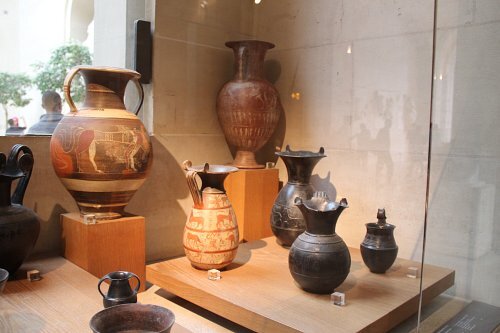 Italic and Etruscan Antiquities (Sully wing, level 1)
When Rome's Neighbors Made Art That Lasted
The Etruscan civilization predates Rome. It flourished in what's now central Italy—Tuscany and surrounding regions—from roughly the 8th century BC until Rome's expansion absorbed it. The Etruscans were traders, builders, wealthy, sophisticated. They wrote, though their language remains partially undeciphered. They made art and left behind enough of it that we can read something of their values and beliefs. Then Rome replaced them. But Etruscan objects survived, and they tell a different story than the Roman story we usually hear.
The Sarcophagus of the Spouses is the anchor piece. Dated to the late 6th century BC, it's a terracotta construction depicting two figures—a man and woman—reclining together on a cushioned bed at a banquet. Their bodies are rendered realistically enough that you can read individual proportions. The man's body is more muscular. The woman's is softer. They wear clothing and jewelry. Their faces are characterized individually. The woman wears a slight smile. What's extraordinary is the intimacy of the object. This wasn't a painting that could hang on a wall. It was a functional container for the dead—a place to hold their remains. The couple reclines inside and on top of this receptacle. They're depicted in a moment of pleasure, at ease with each other, in a posture of social importance. Reclining at banquets was a luxury. Only people of status did this. The sarcophagus announces something about the couple: we mattered, we loved each other (or at least we performed love), we participated in the pleasures of wealth.
Etruscan tomb paintings give a vivid sense of what life looked like. Pigments on stone show scenes of dancing, playing music, hunting, feasting. The style is energetic. Figures are shown in profile with characteristic long-nosed, smiling expressions. The colors are often warm—ochres, reds, blacks. Unlike much Egyptian or Greek funerary art, which emphasizes the rigid and eternal, Etruscan art emphasizes movement and pleasure. People dance. They play lyres. They hunt boar. They recline and feast. If these paintings are accurate, Etruscan culture, at least among the wealthy, valued joy.
Painted tomb plaques from Cerveteri, a major Etruscan city, are scattered throughout the gallery. These are stone plaques from actual tomb walls, removed and preserved. They show the same energy as the other tomb paintings. A figure playing a double flute. A couple in an embrace. Athletes competing. Servants attending to tasks. The inscriptions identify some of the figures, grounding them in individual identity. These aren't anonymous ancestors. They're specific people whose names we sometimes know, who made their mark.
Etruscan bronzes are remarkable for their precision and their variety. Small figurines of animals. Mirror handles carved to depict gods and goddesses. Containers shaped like animals. A bronze lion with individually rendered mane. A bronze horse with delicate legs. The Etruscans were skilled metalworkers. They understood the possibilities of bronze. They could create thin-walled vessels and delicate figures. A bronze utensil might have its handle shaped like a bird. A small container might be fashioned like a rooster. The commitment to merging functionality with sculpture meant that everyday objects could also be art.
Bronze mirrors are particularly sophisticated. The back of the mirror often showed an engraved scene. An engraved depiction of a god or goddess. A scene from myth. The mythology visible on these mirrors overlaps with Greek mythology but isn't identical. The Etruscans had their own gods, their own stories. And they recorded them on objects meant for personal use. A woman would hold a mirror to see her reflection. On the back, she'd see a god or a mythological scene. The object embodied both vanity and spirituality.
Gold jewelry demonstrates technical mastery at the level of obsession. Fibulae—brooch-like pins that held clothing together—made from gold and decorated with granulation and filigree. The granulation involves applying tiny gold spheres to the surface and soldering them in place. It's painstakingly difficult work. The scale is often tiny. A brooch might be no larger than your fingernail but contain this level of detail. Only wealthy people wore gold jewelry, but if you were wealthy, your jewelry announced it unmistakably.
Bucchero is a distinctive Etruscan pottery. It's black throughout, fired in a reducing atmosphere rather than oxidizing atmosphere, creating the color in the body of the clay itself. The forms are often elegant—slender-necked vessels, finely proportioned. Some show wave patterns carved into the surface. Others are undecorated, relying entirely on form. Bucchero ware was exported. Greek colonies imported it. Romans imported it. The technique is specific to Etruria. It shows a level of control over pottery-making that's impressive.
Campana tomb paintings, a later Etruscan tradition, show a shift in style. The colors become more muted. The figures are less energetic. There's an elegance but also a kind of melancholy. By this period, Rome was already dominating. Etruscan independence was ending. The art reflects a culture in transition, still making beautiful things but with a different energy.
What strikes most viewers is how different Etruscan art is from what comes after. Roman art is grand and martial. It celebrates power and order. Greek art emphasizes ideal form and proportion. Etruscan art is playful, sometimes almost comic. It takes pleasure seriously. It decorates everyday objects with care. It renders women as active participants, not merely decorative. The women in Etruscan art move, play music, dance. They're not typically shown in the domestic roles that Greek and Roman imagery emphasized. Etruscan women, at least among the upper classes, apparently had more freedom and visibility than their Greek or Roman counterparts. That's one of the things Etruscan art reveals.
The civilization itself didn't survive Rome's expansion. The culture was absorbed, integrated, transformed. But the objects survived. They're a window onto a world that was sophisticated and different. They show that Rome wasn't the inevitable culmination of Italian history. There were other ways to be, other aesthetics, other values. The Etruscans prove it.