
Early French Painting, 1350 to 1650
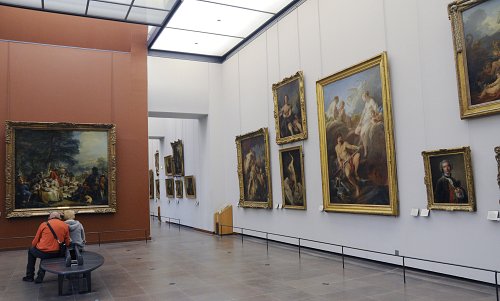 Early French Painting, 1350 to 1650 (Richelieu wing, level 2)
Jean Fouquet's Sharp Observation
Jean Fouquet (c. 1420-1480) brought Flemish precision and Italian perspective into French painting. His Portrait of Charles VII shows the king as a vain, suspicious ruler—small eyes, thin mouth, angular face set against a dark background. There's no flattery in Fouquet's work, just unflinching observation. Fouquet traveled to Rome around 1445 and absorbed Renaissance ideas about light and spatial depth, but he applied them to Northern European panel painting. His miniatures in illuminated manuscripts are so detailed that individual eyelashes are visible. A large painting like the Pietà of Villeneuve-lès-Avignon (attributed to Enguerrand Quarton, a contemporary) shows how French painters of this era merged Flemish detail with Italian volumetric form.
The School of Fontainebleau and Court Mannerism
The School of Fontainebleau emerged from King François I's court at the Château de Fontainebleau, where Italian and Flemish artists worked side by side. The style is mannered, erotic, sophisticated—nothing like the orderly piety of earlier Gothic painting. The painting Gabrielle d'Estrées et une de ses sœurs (c. 1594) exemplifies this: two naked women in a bath, one pinching the other's breast, attendants in the background. The painting is flat, the perspectival space compressed, the bodies elongated. The composition emphasizes pattern and luxury more than realistic anatomy. Artists of the Fontainebleau school included Primaticcio, Niccolò dell'Abate, and anonymous court painters working in a Mannerist idiom that influenced French art for generations.
Portraiture and Court Elegance
Jean Clouet and his son François Clouet dominated French court portraiture in the 16th century. Their small, jewel-like portraits were drawn or painted on panels, showing members of the nobility in three-quarter view against neutral backgrounds. The Clouets used careful hatching and precise detail: every thread in a silk sleeve is rendered, every ringlet of hair. Their work was more linear and less concerned with atmospheric light than Flemish portraiture, yet somehow more intimate. A Clouet portrait has the character of a documented fact—this person, at this moment, in these clothes—while remaining formally elegant. These portraits were collected obsessively by French kings and reproduced in many copies.
Simon Vouet and Early French Baroque
Simon Vouet (1590-1649) spent much of his career in Rome, where he mastered Baroque drama—swirling compositions, rich color, dynamic movement. He returned to Paris as the royal painter and brought Italian Baroque into the French court. Vouet's work is more theatrical than the restrained elegance of earlier French painting. He used deep reds, golds, dramatic shadows. His religious paintings overflow with angels and saints. Yet even his Baroque style never loses a certain French restraint, a preference for clarity over chaos. Vouet's pupils included Le Brun and Le Sueur, and through them his influence shaped French Baroque painting.
Georges de La Tour's Candlelit Interiors
Georges de La Tour (1593-1652) painted small-scale religious scenes lit by a single candle. His paintings have an almost claustrophobic intimacy: Saint Jerome writing by lamplight, Mary Magdalene meditating on a skull, Saint Peter weeping after his denial. The light source in each painting is carefully observed—the warm glow highlighting faces and hands, the rest of the composition dissolving into shadow. La Tour was influenced by Caravaggio's dramatically lit paintings but worked in a more disciplined, austere manner. His paintings are rare and highly prized. Only a handful survive, yet they changed how later artists thought about light and mood in religious art.